
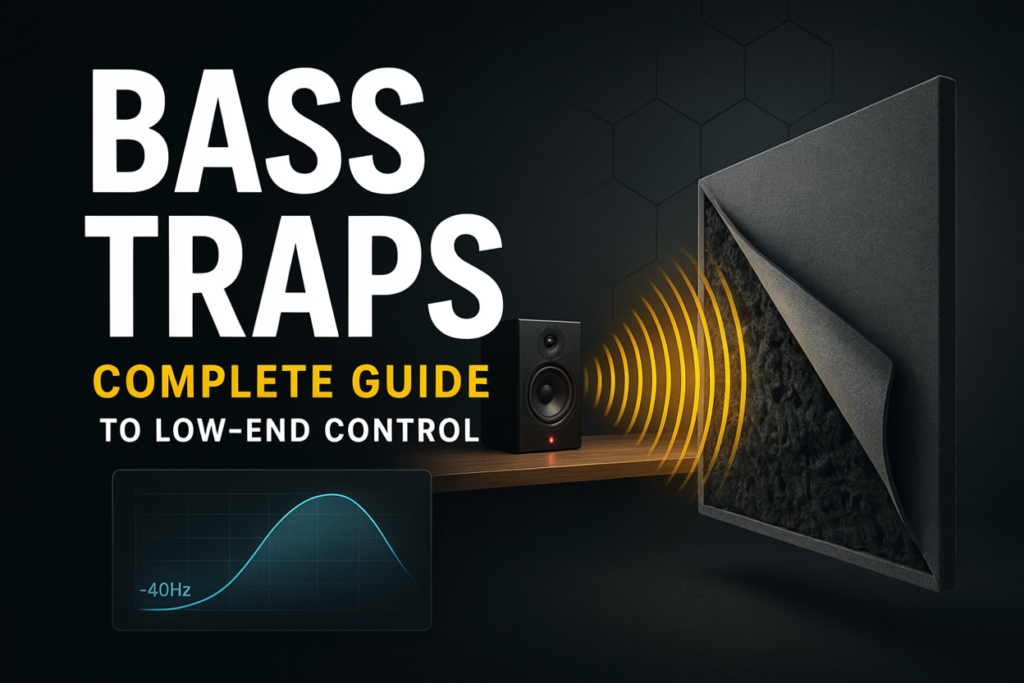
Bass traps are acoustic absorbers that reduce low-frequency room resonances and excessive bass decay. They limit the room’s tendency to make notes boom, disappear, or linger.
Uneven bass is usually a room-and-position problem, not simply a speaker problem. Bass trapping works best as part of a broader room acoustics strategy that considers speaker placement, listening position, reflections, and measured decay.
What Are Bass Traps?
Bass traps absorb more low-frequency energy than ordinary thin wall panels. They can make kick drums and bass notes more consistent while improving mix translation.
Why small rooms produce uneven bass
Low-frequency waves reflect between walls, the floor, and the ceiling. At frequencies related to the room’s dimensions, those reflections form room modes—patterns with high- and low-pressure regions. A listener at one position may hear an exaggerated note, while moving a short distance produces a deep cancellation at the same frequency.
The long wavelengths explain why bass is difficult to control:
| Frequency | Approximate wavelength |
|---|---|
| 50 Hz | 6.86 m |
| 80 Hz | 4.29 m |
| 100 Hz | 3.43 m |
Thin treatments occupy only a small fraction of these wavelengths. An acoustic treatment plan therefore needs more depth for bass control than for flutter echo.
What bass traps can and cannot fix
Bass traps can reduce modal strength and ringing time. They cannot guarantee a flat response, repair every narrow null, or compensate fully for poor speaker and listener positions.
Bass trapping is not soundproofing. Treatment controls reflections; isolation requires sealed, massive, often structurally separated construction.
How Do Bass Traps Work?
Bass traps dissipate acoustic energy through friction, material movement, or resonance. Their useful range depends on mechanism, depth, construction, and placement.
Broadband porous traps
Porous traps use materials such as mineral wool, fiberglass, polyester fibre, or suitable open-cell foam. Greater effective depth generally extends absorption lower, and an air space can help.
Thickness and airflow resistance must work together. The densest material is not automatically best, especially when excessive resistance limits penetration. Standard acoustic panels and their limitations explain why a shallow product should not be assumed to control deep bass.
Membrane and diaphragmatic traps
A membrane trap uses a flexible panel backed by an enclosed, damped cavity. These pressure-reactive absorbers are designed around a target frequency or limited range.
Tuned traps can fit situations where broadband treatment has left one persistent resonance. Their performance is sensitive to panel mass, cavity depth, airtightness, damping, and placement, so improvised dimensions may miss the intended frequency.
Helmholtz and perforated absorbers
A Helmholtz absorber uses a cavity connected through a neck, slot, or opening. Cavity volume, opening dimensions, depth, and damping determine its tuning and bandwidth.
| Feature | Porous trap | Membrane trap | Helmholtz or perforated trap |
| Typical range | Relatively broadband | Usually targeted | Usually targeted |
| Space need | Often physically deep | Can be shallower | Design-dependent |
| Design sensitivity | Moderate | High | High |
| Common use | General small-room control | Known persistent resonance | Defined narrow-band issue |
| Main limitation | Needs depth at very low frequencies | Incorrect tuning reduces value | Sensitive to cavity and openings |
Why Are Bass Traps Placed in Corners?
Corners are useful because modes often have strong pressure at boundaries, while a straddling porous panel creates a large air cavity. Wall-to-wall and wall-to-ceiling junctions can both work.
“Bass collects in corners,” however, is only shorthand. Pressure maxima occur at many boundaries, and porous absorbers depend on air movement through their depth. Pressure-reactive tuned traps and porous traps do not work for exactly the same reason. Corner placement is a strong starting point, not proof that every corner is equally effective.
Which locations should come first?
In a symmetrical mixing room, begin with comparable treatment in the front vertical corners, then evaluate rear corners and ceiling-wall junctions. Deep front- or rear-wall absorption is an alternative where doors or equipment interfere.
Placement should follow stable speaker geometry. A useful home studio acoustics workflow starts by optimizing the listening position before permanent treatment is installed.
How thick should a bass trap be?
There is no universal thickness that works for every room or target frequency. Porous treatment normally needs greater depth as the target frequency falls, while a tuned absorber’s dimensions depend on its design. Thin foam wedges may reduce midrange and high-frequency reflections yet do little for a 50 Hz modal problem.
An air cavity increases effective depth. Compare frequency-band test results for the complete mounting configuration rather than relying on shape, density, or product name.
How Should You Install and Test Bass Traps?
Install bass traps in stages and measure consistently. Frequency response shows peaks and nulls; waterfall plots also show lingering low-frequency energy.
- Finalize the speaker and listening positions.
- Measure the untreated room at the listening position and nearby seats.
- Add symmetrical broadband treatment in available vertical corners.
- Remeasure frequency response and decay using the same setup.
- Treat useful boundary or ceiling-wall areas if problems remain.
- Consider a tuned absorber only for a clearly identified residual resonance.
- Verify the final result by measurement and critical listening.
Multiple microphone positions separate local cancellation from broader decay. If a deep null exists only at one seat, moving the listener or speakers may help more than another absorber. Guidance on setting up a recording room can prevent treatment from solving the wrong problem.
How many bass traps do you need?
No fixed panel count applies universally. Coverage depends on room volume, modal behaviour, absorber depth, available locations, and required accuracy. Add treatment in measured stages rather than purchasing by count alone.
| What you notice | Likely issue | Useful next check |
| One note booms and lingers | Strong modal resonance | Inspect frequency and decay plots |
| A narrow bass note disappears at one seat | Position-related cancellation | Measure nearby positions |
| Left and right sound unequal | Layout or boundary asymmetry | Check placement before adding treatment |
| Highs sound dry but bass still rings | Too much shallow absorption | Add deeper, frequency-appropriate control |
| Treatment makes little difference | Poor location or insufficient depth | Verify mounting and low-band performance |
Average ratings can hide these differences. Review individual frequency-band absorption coefficients and the tested mounting method; NRC alone does not demonstrate meaningful performance below 125 Hz.
How Do You Choose a Bass Trap?
Choose a trap by matching verified low-frequency performance to a measured problem. Broadband porous treatment suits multiple issues; a tuned absorber may address one stubborn resonance.
Check material depth, installed depth, mounting configuration, and third-octave low-frequency data. Also assess secure mounting, ventilation clearance, durability, and applicable fire information.
Avoid judging performance from triangular shape or marketing language. A product called a bass trap may behave mostly as a mid-high absorber if it lacks sufficient effective depth. Likewise, adding more shallow absorption can make a room dull without solving long bass decay. Comparing the result with a sensible target reverberation-time range is more useful than chasing one isolated rating.
Diffusion is not a substitute for bass trapping either. Acoustic diffusion principles concern redistributing reflected energy, while a bass trap is intended to dissipate it. Small rooms often need low-frequency absorption before diffusion becomes the priority.
Frequently Asked Questions
Do bass traps make a room sound less bass-heavy?
Bass traps usually make bass more even and controlled rather than simply quieter. Boomy frequencies may become less dominant, while previously masked notes can become easier to hear.
Are foam corner wedges effective bass traps?
Effectiveness depends on material properties, depth, mounting, and the target frequency. Small foam wedges may absorb upper bass or midrange energy but should not be assumed to control deep room modes without verified low-frequency data.
Do bass traps need to cover every corner?
No. Treating every corner can help in some rooms, but placement should follow available space, symmetry, and measurements. Start with high-priority locations, then test before adding more.
Can bass traps fix a deep frequency-response null?
Bass traps can reduce modal severity, but a deep narrow null caused by cancellation at one position may respond better to moving the speakers or listener. Measure several nearby positions before treating the null as a room-wide problem.
Are floor-to-ceiling bass traps necessary?
Floor-to-ceiling coverage provides more absorber area and can improve consistency, but it is not mandatory in every room. Partial-height traps or ceiling-wall treatment may work when doors, equipment, or budget restrict coverage.
What is the difference between bass trapping and soundproofing?
Bass trapping absorbs low-frequency energy inside a room to improve acoustic response. Soundproofing reduces transmission between spaces through construction methods such as mass, airtightness, damping, and structural separation.

Noah Bennett is an audio engineering writer and acoustics specialist at Reverb Calculator. He focuses on reverb time calculation, room acoustics, studio sound design, and music production tools for producers, audio engineers, musicians, and home studio creators.