
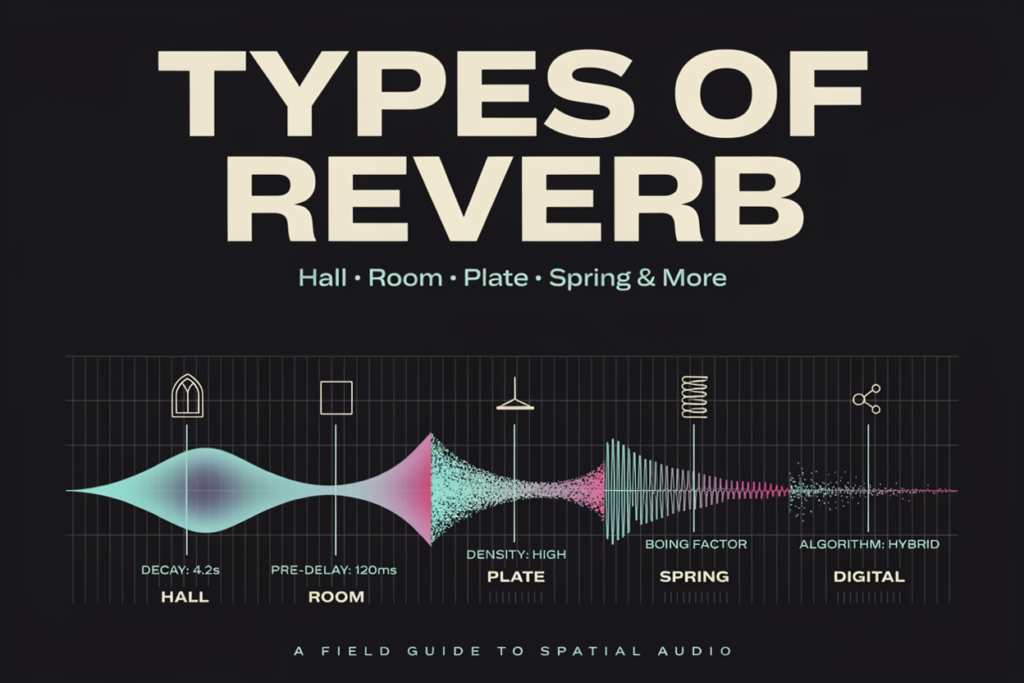
Reverb types include room, hall, chamber, ambience, plate, spring, algorithmic, convolution, gated, and shimmer. These names don’t describe the same property: some identify a space, some a physical device, some a digital generation method, and others a creative treatment.
Choose how large the space should feel, how the tail should behave, and whether the result should sound natural or stylized. For a foundation, see how reverberation works.
What Are the Main Types of Reverb?
The main types of reverb can be organized into four useful groups: acoustic spaces, mechanical devices, digital methods, and creative effects. A single preset can belong to several groups at once, such as an algorithmic hall with a shimmer effect.
| Category | Main examples | What the label describes |
|---|---|---|
| Acoustic spaces | Room, hall, chamber, ambience | The size and reflection character being simulated |
| Mechanical devices | Plate, spring | The physical mechanism originally used to create the sound |
| Digital methods | Algorithmic, convolution | How a processor generates or reproduces the reverb |
| Creative effects | Gated, shimmer, reverse | How the reverb tail is altered |
Room and hall describe environments; plate and spring refer to hardware. Algorithmic and convolution describe processing methods, while gating and shimmer can modify several underlying sounds.
That overlap explains why a preset may be both an algorithmic hall and a shimmer effect.
How Do Room, Hall, Chamber, and Ambience Reverbs Differ?
Room, hall, chamber, and ambience simulate different scales and reflection patterns. Room and ambience add subtle cohesion; hall and chamber provide more sustain and depth.
| Type | Perceived space | Typical character | Common uses |
| Room | Small to medium | Compact, natural, early-reflection focused | Drums, guitars, vocals, mix cohesion |
| Hall | Large | Smooth, spacious, long, gradually developing | Vocals, piano, strings, orchestral music |
| Chamber | Medium to large reflective room | Dense, lively, present | Vocals, drums, acoustic instruments |
| Ambience | Very short environment | Subtle, immediate, often tail-light | Adding depth without obvious reverb |
Room reverb creates the impression of a relatively small enclosed space. Closely spaced early reflections communicate boundaries quickly, so the source can feel grounded without acquiring a long, dramatic tail.
A shared room send can make tracks recorded at different times feel as though they belong in one environment. The deeper room ambience guide explains how early reflections, decay, and direct-to-reverberant balance affect that illusion.
Hall reverb suggests a much larger space, generally with a smoother buildup and longer decay. It can add grandeur and depth, but its sustained tail may mask detail in a dense arrangement. The hall reverb overview covers ways to preserve definition while creating scale.
Chamber reverb is often denser and more energetic than a subtle room, yet less vast than a concert hall. It suits sources needing presence rather than extreme distance.
How Do Plate and Spring Reverbs Create Their Sound?
Plate and spring reverbs began as electromechanical devices. A plate uses suspended metal; a spring sends vibrations through coils. Each has a recognizable resonance.
In a traditional plate system, a transducer excites a metal plate and pickups capture its vibrations. The dense, polished tail does not imitate a normal room precisely.
Plate reverb suits vocals, snare drums, and instruments needing sustain without an obvious room identity. Learn more in the plate reverb explanation.
Spring reverb passes vibration through coiled springs. Its dispersion and resonances produce a metallic, bouncing, or “drippy” character.
Spring sounds are closely linked with guitar amplifiers, surf guitar, organs, and dub production. The spring reverb guide examines the mechanism and its characteristic splash. Digital emulations can retain this identity while adding controls unavailable on original hardware.
What Is the Difference Between Algorithmic and Convolution Reverb?
Algorithmic reverb synthesizes reflections with delays, feedback, filters, diffusion, and modulation. Convolution applies an impulse response, or IR, measured from a room or device.
| Feature | Algorithmic reverb | Convolution reverb |
| Source | Mathematically generated network | Recorded impulse response |
| Editing freedom | Usually extensive | Often constrained by the selected IR |
| Movement | Can include active modulation | A static IR does not change over time |
| Realism | Plausible or intentionally unreal | Reproduces one measured response |
| Best suited to | Flexible mixing and creative spaces | Specific room or hardware character |
Algorithmic designs let you reshape size, decay, density, damping, and modulation. They can create convincing rooms or physically impossible spaces. The algorithmic processing guide explains delay networks and diffusion.
Convolution is valuable when a captured environment or device matters. An IR measures one source-and-microphone arrangement, so it is a snapshot rather than a complete model of every position.
The impulse-response reverb guide explains capture, deconvolution, position dependence, and static-response limitations.
What Are Gated, Shimmer, and Other Creative Reverb Effects?
Gated, shimmer, reverse, and nonlinear reverbs modify the timing or pitch behavior of a reverb rather than identifying one basic environment. These treatments are chosen for musical impact, not strict acoustic realism.
Gated reverb starts with a dense reverb, then cuts the tail with a gate or envelope. The source gains scale, but the effect stops before a long decay fills the mix.
The technique suits drums, vocals, claps, and sound effects. The gated-tail technique covers threshold, hold, release, and timing.
Shimmer adds pitch-shifted signal, commonly an octave above, to the feedback path. Recirculation builds an airy, synthetic, or orchestral upper layer.
Too much feedback or high-frequency energy can make shimmer harsh and obscure the source. Reverse reverb instead swells toward the dry sound, creating anticipation rather than a natural decay.
Which Type of Reverb Should You Choose?
Choose reverb by the musical job first: cohesion, depth, sustain, realism, or special effect. Then match decay, density, tone, and pre-delay to the tempo and arrangement instead of relying on an instrument label alone.
| Musical goal | Useful starting point | Why |
| Make separate tracks feel connected | Short room or ambience | Adds shared spatial cues with limited tail |
| Add vocal sustain | Plate, chamber, or hall | Creates density and depth around held notes |
| Keep drums powerful and controlled | Room, plate, or gated reverb | Supports transients without requiring a long wash |
| Reproduce a particular place | Convolution reverb | Applies a captured room response |
| Create an unreal atmosphere | Algorithmic or shimmer reverb | Offers extensive shaping and movement |
| Add vintage guitar character | Spring reverb | Supplies resonant, splashy coloration |
- Decide whether the source needs subtle placement, obvious sustain, or a creative tail.
- Set the wet level high enough to hear the character, then compare options at roughly equal perceived loudness.
- Adjust decay to fit the gaps between notes or hits.
- Use pre-delay when the dry transient or lyric needs clearer separation.
- Filter unnecessary low and high frequencies from the return.
- Lower the wet level and judge the effect in the full mix.
A plate can sound muddy if its decay and lows are excessive; a room can sound detached if pre-delay is too long. Judge whether the intended space leaves the arrangement intelligible.
Frequently Asked Questions About Reverb Types
How Many Types of Reverb Are There?
There is no fixed total because the names describe overlapping spaces, devices, digital methods, and creative treatments. Room, hall, chamber, ambience, plate, spring, algorithmic, convolution, gated, and shimmer are common categories.
What Is the Most Natural-Sounding Type of Reverb?
Convolution can reproduce the measured character of a specific space, while a well-designed algorithmic room or hall can also sound natural. Realism depends on the source, settings, impulse response, and wet/dry balance.
What Is the Difference Between Room, Hall, and Chamber Reverb?
Room reverb is compact and early-reflection focused, hall reverb is larger and smoother, and chamber reverb is dense and lively. Their decay ranges overlap, so reflection pattern and tone matter as much as length.
Is Plate or Hall Reverb Better for Vocals?
Plate reverb adds smooth density without imposing a realistic room, while hall reverb creates greater scale and distance. Choose according to the arrangement, vocal tone, tempo, and desired intimacy.
Can a Reverb Be Both Algorithmic and Hall Reverb?
Yes. “Algorithmic” describes how the effect generates reverberation, while “hall” describes the kind of space it is designed to suggest. A preset can also add shimmer or gating, giving it a third descriptive label.
Which Reverb Type Works Best for Drums?
Short rooms add cohesion, plates give a snare density, and gated reverbs create controlled impact. Tune decay and low-frequency content so the tail does not blur the rhythm.

Noah Bennett is an audio engineering writer and acoustics specialist at Reverb Calculator. He focuses on reverb time calculation, room acoustics, studio sound design, and music production tools for producers, audio engineers, musicians, and home studio creators.