
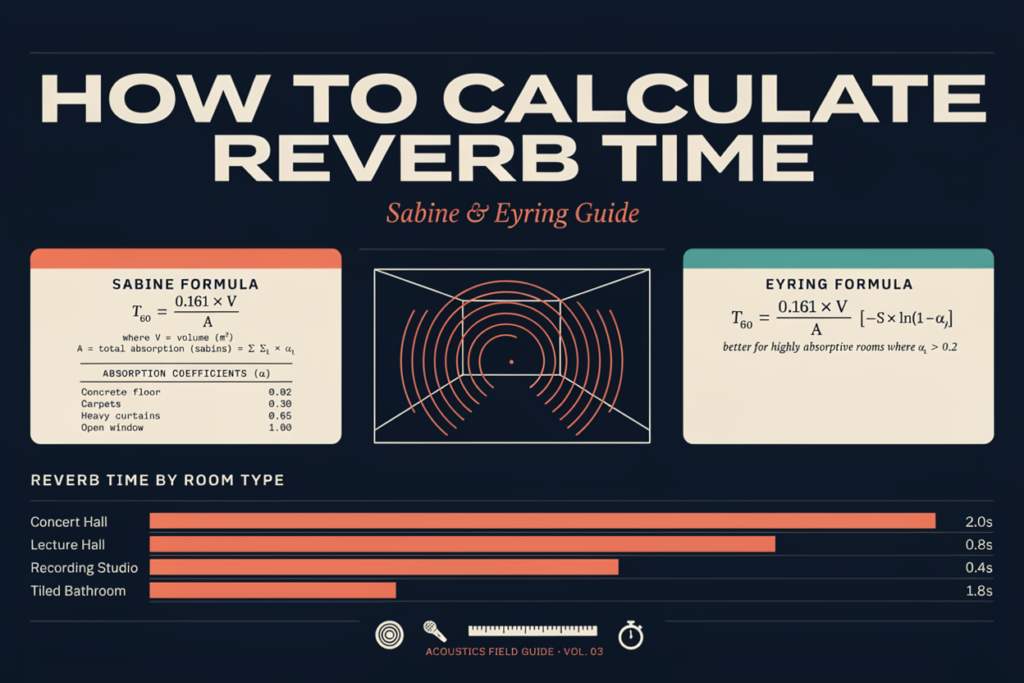
Reverb time is the time sound takes to decay after the original source stops. The standard measurement is RT60, meaning the number of seconds required for the sound level to fall by 60 decibels.
A short RT60 makes a room sound dry and controlled. A long RT60 produces a more reflective, spacious, or echoey sound. Understanding how reverberation time is defined helps when evaluating rooms for recording, mixing, speech, rehearsal, or performance.
Why RT60 Uses a 60 dB Decay
A 60 dB reduction represents a major loss of sound energy. However, the full decay is often hidden by background noise, so acousticians commonly measure a shorter section and extrapolate it.
Why Frequency Matters
Reverb time is rarely identical across the frequency spectrum. A room may have controlled midrange decay but continue ringing in the bass. For meaningful results, calculate or measure RT60 in octave bands such as 125 Hz, 250 Hz, 500 Hz, 1 kHz, 2 kHz, and 4 kHz.
How Do You Calculate Reverb Time With the Sabine Formula?
The standard metric equation is:
RT60 = 0.161V ÷ A
Here, V is room volume in cubic metres and A is total equivalent absorption area in square metres of sabins.
Step 1: Calculate Room Volume
Multiply the room’s length, width, and height:
V = length × width × height
A room measuring 5 metres by 4 metres by 3 metres has a volume of:
5 × 4 × 3 = 60 m³
Use the full room volume, not its floor area.
Step 2: Calculate Each Surface Area
Measure the floor, ceiling, walls, windows, doors, and major treatment surfaces. Separate areas made from different materials because their absorption values will differ.
For a rectangular room:
- Floor and ceiling = length × width
- Long walls = 2 × length × height
- Short walls = 2 × width × height
Step 3: Find Absorption Coefficients
An absorption coefficient indicates how much incident sound a material absorbs. Values range from 0 to 1.
A coefficient near 0 means little sound is absorbed. A value near 1 means most incident sound is absorbed at that frequency. Because coefficients change across the spectrum, use frequency-specific material absorption values whenever possible.
Step 4: Calculate Total Absorption
Multiply each surface area by its absorption coefficient, then add the results:
A = S₁α₁ + S₂α₂ + S₃α₃ + …
In this expression, S is surface area and α is the absorption coefficient.
Step 5: Calculate RT60
Insert the room volume and total absorption into the complete RT60 equation:
RT60 = 0.161V ÷ A
For imperial measurements, the equation is commonly written as:
RT60 = 0.049V ÷ A
Volume must then be in cubic feet and absorption area in square feet of sabins.
Worked Example: Calculating RT60 for a Small Room
Consider a 5 m × 4 m × 3 m room. The example uses simplified absorption values for one frequency band.
Calculate Volume and Absorption
The volume is:
V = 5 × 4 × 3 = 60 m³
Assume the following surfaces:
| Surface | Area | Coefficient | Absorption |
|---|---|---|---|
| Carpeted floor | 20 m² | 0.25 | 5.00 |
| Plaster ceiling | 20 m² | 0.05 | 1.00 |
| Painted walls | 54 m² | 0.05 | 2.70 |
| Acoustic panels | 6 m² | 0.80 | 4.80 |
Total equivalent absorption is:
A = 5.00 + 1.00 + 2.70 + 4.80 = 13.50 m² sabins
Calculate the Final RT60
RT60 = 0.161 × 60 ÷ 13.50
RT60 ≈ 0.72 seconds
A result of 0.72 seconds may suit some listening or rehearsal rooms but could be longer than desired for tightly controlled recording. The appropriate target depends on room size and purpose, so compare the result with guidance on choosing a suitable decay target.
When Should You Use the Eyring Formula?
The Eyring formula is often more appropriate when average absorption is high. Sabine assumes relatively low, evenly distributed absorption and may overestimate decay in heavily treated rooms.
The metric equation is:
RT60 = −0.161V ÷ [S ln(1 − ᾱ)]
Here, S is total surface area and ᾱ is the average absorption coefficient.
Compare Sabine and Eyring
For the example room:
S = 20 + 20 + 54 + 6 = 100 m²
ᾱ = A ÷ S = 13.50 ÷ 100 = 0.135
Applying the Eyring equation gives approximately 0.67 seconds, compared with the Sabine result of 0.72 seconds. The difference is small because the room’s average absorption is modest. The gap becomes larger as absorption increases. See when the Eyring calculation is more suitable for a fuller comparison.
How Can You Measure Reverb Time From a Recording?
You can measure reverb time by recording a room’s sound decay, plotting the level over time, and calculating how long a 60 dB reduction would take. Measurement often reflects real room behaviour more accurately than a formula.
Record a Room Impulse Response
Common test signals include a swept sine played through a speaker, interrupted broadband noise, a balloon burst, or a handclap. Informal methods can provide an estimate, but calibrated equipment gives more dependable frequency-specific results.
Calculate the Decay Rate
Measurement software converts the recording into an energy decay curve. The curve must remain above the background-noise floor.
When the complete decay is unavailable, use:
- T20: measure approximately −5 dB to −25 dB and multiply the time by 3.
- T30: measure approximately −5 dB to −35 dB and multiply the time by 2.
If a 20 dB decay takes 0.30 seconds:
RT60 = 0.30 × 3 = 0.90 seconds
What Is the Difference Between RT60, T20, and T30?
RT60 is the target 60 dB decay time. T20 and T30 measure shorter clean decay ranges and extrapolate them to 60 dB.
| Metric | Typical range | Extrapolation | Best use |
| RT60 | About −5 to −65 dB | None | Direct full-decay measurement |
| T20 | About −5 to −25 dB | Multiply by 3 | Limited clean decay range |
| T30 | About −5 to −35 dB | Multiply by 2 | More stable practical estimate |
What Causes Inaccurate Calculations?
Common errors include using floor area instead of volume, applying one absorption coefficient to every frequency, and averaging coefficients without weighting them by surface area.
Furniture, people, curtains, doors, openings, and large equipment also affect decay. Real rooms may contain uneven treatment, strong room modes, and non-diffuse reflections that basic formulas cannot fully model.
Treat calculated RT60 as a planning estimate. Confirm important acoustic decisions by measuring the finished room and performing a broader assessment of the room’s acoustics.
How Should You Interpret the Result?
A lower RT60 is not automatically better. Speech rooms generally need controlled decay for intelligibility, while music spaces may benefit from longer reverberation. Recording and mixing rooms usually require shorter, more even decay.
Also compare frequency bands. A room with a 0.4-second midrange decay and a 1.2-second bass decay may still sound muddy. When decay is excessive, plan the placement and frequency coverage of treatment before reducing unwanted sound reflections.
Frequently Asked Questions
Can I calculate reverb time with a phone?
A phone can provide a rough estimate with a suitable recording or acoustic-analysis application. Its microphone, automatic gain control, speaker response, and surrounding noise can reduce accuracy.
How do I calculate RT60 from a 20 dB decay?
Measure the time required for the level to fall by 20 dB, usually from approximately −5 dB to −25 dB, and multiply it by 3. A 0.40-second T20 corresponds to an estimated RT60 of 1.20 seconds.
Is RT60 different at each frequency?
Yes. Materials, room modes, and air absorption affect frequencies differently. Octave-band results provide a more useful acoustic profile than one broadband figure.
Does acoustic treatment reduce RT60?
Absorptive treatment reduces reverb time in the frequencies it effectively absorbs. Diffusion mainly redistributes reflections, while bass traps target low-frequency decay and modal problems.
Is the Sabine formula reliable for a small studio?
It provides a useful starting estimate, but small studios often have uneven sound fields and strong room modes. Measurements are better for final decisions, although understanding how the Sabine method works remains useful for planning.

Noah Bennett is an audio engineering writer and acoustics specialist at Reverb Calculator. He focuses on reverb time calculation, room acoustics, studio sound design, and music production tools for producers, audio engineers, musicians, and home studio creators.