
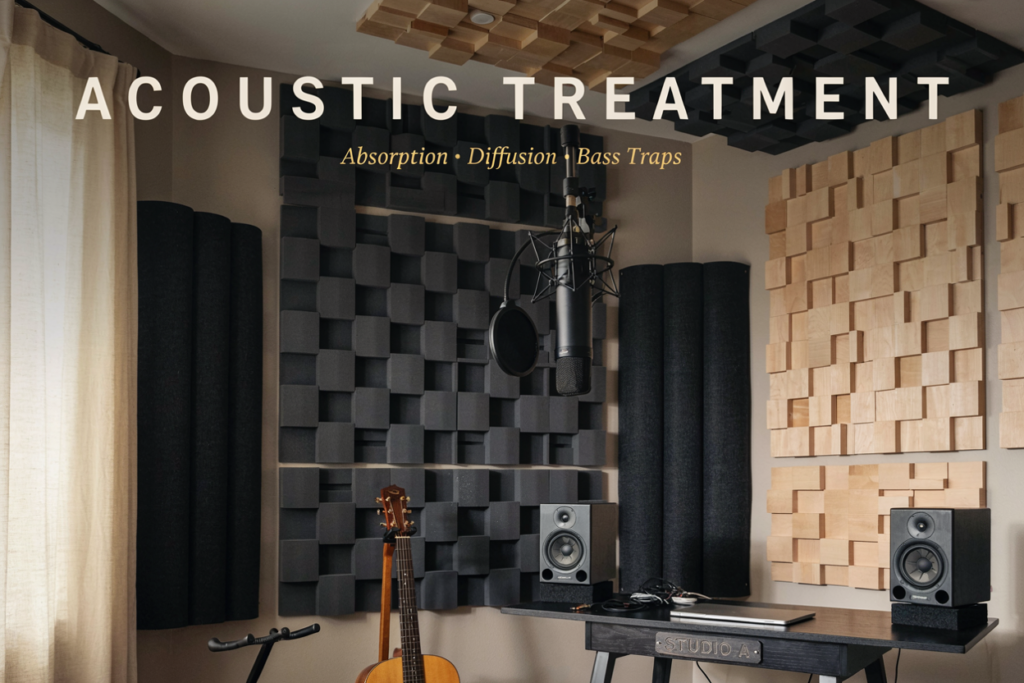
Acoustic treatment is the controlled use of absorbers, bass traps and diffusers to manage reflections, reverberation and resonances inside a room. It can make recordings cleaner and monitoring decisions more reliable, but it does not stop sound from passing through walls, doors or ceilings.
A useful plan starts with the room’s actual problems rather than a fixed panel count. Speaker position, listening position and room dimensions affect what should be treated first. For the wider principles, see this guide to room acoustics.
What Is Acoustic Treatment?
Acoustic treatment changes sound within a room. Absorption reduces reflections, bass trapping controls low-frequency resonances and diffusion scatters sound.
Treatment can improve stereo imaging, speech intelligibility, recording clarity, bass consistency and confidence in mix decisions. It can also reduce flutter echo and excessive reverberation.
Acoustic treatment versus soundproofing
Acoustic treatment and soundproofing solve different problems. Treatment improves sound inside the room; soundproofing reduces sound transmission between the room and surrounding spaces.
Absorbers may reduce reflected sound reaching a microphone, but they cannot replace airtight construction, added mass or structural decoupling. Thin wall foam is not an isolation solution.
How Do Absorption, Bass Trapping and Diffusion Work?
Each treatment type addresses a different problem. Most small studios need a combination, but absorption and bass control usually take priority over diffusion.
| Room problem | Likely cause | Useful treatment | Common placement |
|---|---|---|---|
| Blurred stereo image | Early sidewall or ceiling reflections | Broadband absorbers | First-reflection points |
| Uneven bass | Axial, tangential or oblique room modes | Bass traps | Corners and boundary junctions |
| Flutter echo | Repeated reflections between parallel surfaces | Absorption or diffusion | Opposing bare walls |
| Room sounds too dead | Excessive high-frequency absorption | Diffusion or reduced coverage | Rear half of a suitable room |
| Long, muddy decay | Insufficient broadband and low-frequency absorption | Thick absorbers and bass trapping | Corners, rear wall and ceiling |
Broadband absorbers
Porous absorbers convert some sound energy into heat as air moves through fibrous or open-cell material. Panel thickness, material airflow resistance and mounting depth determine the frequency range affected. The acoustic panel fundamentals explain why a thick panel generally reaches lower than a thin panel made from similar material.
An air gap behind a porous panel can improve lower-frequency effectiveness. It does not turn a thin panel into a deep-bass trap, but it can extend useful absorption.
Bass traps
Bass traps reduce low-frequency ringing and level variation caused by room modes. Corners are common starting points because multiple boundaries meet there and modal pressure is often high. Wall-to-wall, wall-to-ceiling and trihedral corners can all be useful locations.
Low bass has long wavelengths, so effective control normally needs substantial depth or a tuned design. This bass-trap placement guide helps prioritize limited space.
Diffusers
Diffusers redirect sound rather than removing most of its energy. They preserve liveliness but need enough distance for the scattered field to develop. In a very small room, thick rear-wall absorption is often more predictable.
What Should You Treat First in a Home Studio?
Treat the largest verified problems first: optimize the layout, control low-frequency decay and reduce early reflections. Buying random panels before fixing speaker and seat placement can waste both space and budget.
- Position the speakers symmetrically relative to the sidewalls.
- Move the listening position away from the exact center of the room.
- Test several speaker and seat positions for smoother bass.
- Add bass trapping where measurements show persistent low-frequency decay.
- Treat sidewall and ceiling first-reflection points.
- Evaluate the rear wall and remaining flutter echo.
- Re-measure before adding more treatment.
Moving the listening position may improve a deep cancellation that absorption cannot practically fix. This home studio acoustics workflow connects layout, monitoring and treatment.
First reflections and the ceiling
First reflections arrive shortly after the direct sound and can interfere with it, producing comb filtering and less precise imaging. Sidewall panels and a ceiling cloud reduce these competing arrivals.
To find a sidewall reflection point, sit in position while another person slides a mirror along the wall. Mark where each speaker becomes visible and repeat on both sides. Treat a broad enough area to allow for head movement.
How Much Acoustic Treatment Does a Room Need?
There is no universal number of panels or ideal wall-coverage percentage. A voice booth, control room and live tracking room require different balances of direct sound, decay and spaciousness.
Start with important locations, then judge frequency response and decay. An ideal RT60 overview provides context, but small-room quality cannot be reduced to one number. Bass ringing may remain when mid-frequency decay looks acceptable.
Covering every surface with thin material can remove high-frequency energy while leaving bass uncontrolled, creating a dull yet boomy room. Aim for reasonably even decay across frequencies.
How Do You Choose Acoustic Treatment Materials?
Choose materials by frequency-specific absorption data, required depth, fire rating, installation method and room purpose. Marketing labels such as “studio grade” reveal less than measured performance.
Absorption coefficients show the fraction of incident energy absorbed at test frequencies. A value near 1.00 indicates high absorption under the stated conditions. This sound absorption coefficient guide explains the bands and mounting conditions.
Noise Reduction Coefficient, or NRC, is a rounded average based on absorption at 250, 500, 1,000 and 2,000 Hz. It is useful for a quick mid-frequency comparison, but it does not describe deep-bass performance. Two products with similar NRC ratings may behave very differently below 125 Hz.
Foam versus thicker porous panels
Thin acoustic foam can reduce flutter echo and high-frequency reflections, but it usually has limited effect on low-frequency modes. Thicker mineral-wool, fiberglass or suitable fiber panels generally provide broader absorption when their density, depth and mounting are appropriate.
Egg cartons are not substitutes for tested absorbers or diffusers. Their shallow, irregular surface may scatter a small amount of high-frequency energy, but they do not provide meaningful broadband or bass control and may introduce a fire risk.
How Can You Test Whether Treatment Is Working?
Compare the room before and after treatment using the same speaker levels, microphone position and measurement settings. Listening reveals practical changes, while measurements show frequency and time-domain problems that are easy to miss.
A hand clap can reveal flutter echo but cannot diagnose bass response. Use consistent test sweeps to examine frequency response, decay and early reflections. Change one major variable at a time.
Keep the treatment that improves both measured behavior and real work. A smoother graph is useful only if monitoring translates better and recordings need less corrective processing. When planning an entire room, this recording studio setup sequence helps keep acoustic decisions aligned with equipment and workflow.
What Acoustic Treatment Mistakes Should You Avoid?
The most common mistake is treating visible wall space instead of the room’s measured problems. Thin foam, random asymmetrical placement and excessive high-frequency absorption can make a room look treated without producing dependable monitoring.
Avoid placing absorbers only behind the speakers while leaving sidewall reflections and corners untreated. Do not assume that every rear wall needs diffusion; listening distance, diffuser depth and design frequency matter. The practical limits of acoustic diffusion are especially important in compact rooms.
Also avoid treating before optimizing the layout, relying on NRC alone, or expecting furniture to behave like predictable broadband treatment. A sofa and filled bookshelf may help in some frequency ranges, but neither comes with reliable placement-specific performance data.
Frequently Asked Questions
Can acoustic treatment reduce noise heard by neighbors?
Acoustic treatment may slightly reduce the reflected energy in a room, but it is not designed to prevent transmission. Meaningful isolation usually requires sealing air gaps and improving the mass, decoupling and structural design of the room boundaries.
Should acoustic panels touch the wall or have an air gap?
Both mounting methods can work, but an air gap often extends a porous panel’s useful absorption toward lower frequencies. The gap should be secure and planned as part of the panel’s total depth rather than treated as a replacement for adequate absorber thickness.
Does every room need acoustic diffusion?
No. Diffusion is most useful when the room and listening distance allow scattered reflections to develop. In a small studio with a nearby rear wall, broadband absorption may provide a more controlled result.
Can furniture replace purpose-built acoustic treatment?
Soft furniture, curtains and bookshelves can change reflections, but their performance is uneven and difficult to predict. Furniture can complement a treatment plan, but it should not be assumed to solve first reflections or low-frequency modal decay.
Is it possible to install too much absorption?
Yes. Excessive thin absorption can remove high frequencies while leaving the low end uncontrolled, producing an unbalanced room. Add treatment in stages and verify frequency response, decay and listening translation after each major change.

Noah Bennett is an audio engineering writer and acoustics specialist at Reverb Calculator. He focuses on reverb time calculation, room acoustics, studio sound design, and music production tools for producers, audio engineers, musicians, and home studio creators.