
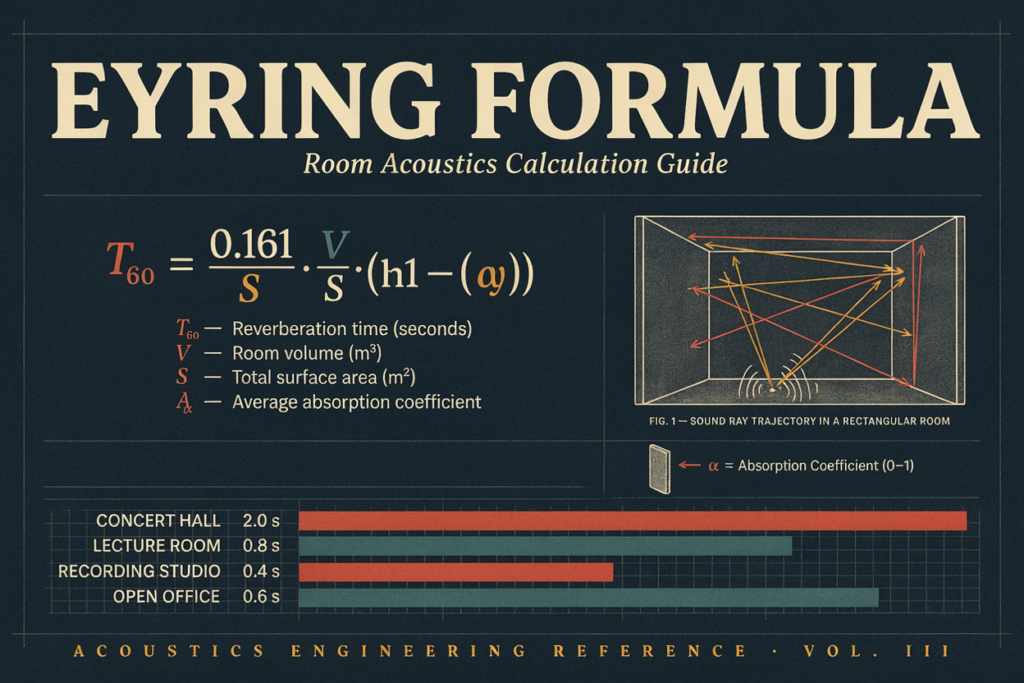
The Eyring formula estimates reverberation time by relating room volume, total boundary area, and average sound absorption. It is especially useful when a room is relatively absorptive, because its logarithmic term represents the fraction of sound energy that remains after repeated reflections more realistically than the basic Sabine equation.
Reverberation time is usually expressed as RT60—the time required for sound level to decay by 60 dB after the source stops. This guide to reverberation time and sound decay explains how reflections combine into measurable decay.
What Is the Eyring Formula?
In SI units, the Eyring reverberation-time equation is:
[
RT_{60}=\frac{-0.161V}{S\ln(1-\bar{\alpha})}
]
The minus sign is necessary because (\ln(1-\bar{\alpha})) is negative whenever the mean absorption coefficient is between 0 and 1. The resulting RT60 is positive.
Carl F. Eyring introduced the equation in his 1930 paper “Reverberation Time in ‘Dead’ Rooms.” It extended statistical calculations to more absorptive spaces than those behind Wallace Clement Sabine’s earlier work.
What does each variable mean?
| Symbol | Meaning | SI unit |
|---|---|---|
| (RT_{60}) | Time for a 60 dB sound-level decay | seconds |
| (V) | Enclosed room volume | cubic metres |
| (S) | Combined area of the floor, ceiling, and walls | square metres |
| (\bar{\alpha}) | Area-weighted mean absorption coefficient | dimensionless |
| (\ln) | Natural logarithm | dimensionless |
The constant 0.161 applies when volume is in cubic metres and area in square metres. Keep units consistent. For more detail on the decay convention, see what RT60 means.
Why does the equation use a logarithm?
At each boundary encounter, a surface absorbs a fraction of the incident sound energy and reflects the rest. Eyring models this repeated fractional loss with (-\ln(1-\bar{\alpha})).
When absorption is low, (-\ln(1-\bar{\alpha})) is close to (\bar{\alpha}), so Eyring and Sabine produce similar estimates. As absorption rises, the logarithmic term becomes larger than the coefficient itself. The Eyring denominator therefore increases and its predicted RT60 becomes shorter.
How Do You Calculate RT60 With the Eyring Formula?
Calculate the room’s volume and total boundary area, find the area-weighted mean absorption coefficient, and substitute the results into the equation. Absorption varies by frequency, so a serious analysis repeats the process for each available octave or one-third-octave band.
- Calculate room volume: (V=L\times W\times H).
- Add the areas of the floor, ceiling, and every wall to obtain (S).
- Multiply each surface area (S_i) by its absorption coefficient (\alpha_i).
- Add those absorption areas and divide by total area:
[
\bar{\alpha}=\frac{\sum S_i\alpha_i}{S}
]
- Evaluate (\ln(1-\bar{\alpha})), then solve the Eyring equation.
This is the same weighted-input principle used in a general RT60 formula calculation, but Eyring applies the logarithmic correction to the mean coefficient.
Worked Eyring formula example
Consider a 5 m × 4 m × 3 m room:
[
V=5\times4\times3=60\text{ m}^3
]
The floor and ceiling are each (5\times4=20\text{ m}^2). The two long walls total (2(5\times3)=30\text{ m}^2), and the two short walls total (2(4\times3)=24\text{ m}^2). Therefore:
[
S=20+20+30+24=94\text{ m}^2
]
For a simplified teaching example, suppose the surfaces have these representative coefficients at one frequency band:
| Surface group | Area (S_i) | Coefficient (\alpha_i) | Absorption area (S_i\alpha_i) |
| Floor | 20 m² | 0.10 | 2.0 m² |
| Ceiling | 20 m² | 0.50 | 10.0 m² |
| Walls | 54 m² | 0.30 | 16.2 m² |
| Total | 94 m² | — | 28.2 m² |
The weighted mean is:
[
\bar{\alpha}=\frac{28.2}{94}=0.30
]
Now substitute the values:
[
RT_{60}=\frac{-0.161(60)}{94\ln(1-0.30)}
=\frac{-9.66}{94\ln(0.70)}
\approx0.29\text{ s}
]
The coefficients above demonstrate the method; they are not measurements from a particular room. Real coefficients should match the material, mounting method, and frequency band. Published sound absorption coefficients are normally reported as frequency-dependent values.
How should multiple materials be combined?
Always weight each coefficient by the area it covers. A simple unweighted average may happen to work in this balanced example, but it fails when the areas differ. Use (\sum S_i\alpha_i/S), including significant doors and windows where suitable data exist.
How Is Eyring Different From the Sabine Formula?
Sabine divides (0.161V) by equivalent absorption area, while Eyring replaces the mean coefficient with a logarithmic absorption term. The two estimates are close in reflective rooms; Eyring generally predicts a shorter decay as average absorption increases.
| Model | SI equation | Result for the example room |
| Sabine | (RT_{60}=0.161V/(S\bar{\alpha})) | 0.34 s |
| Eyring | (RT_{60}=-0.161V/[S\ln(1-\bar{\alpha})]) | 0.29 s |
For Sabine:
[
RT_{60}=\frac{0.161(60)}{94(0.30)}\approx0.34\text{ s}
]
Both models use the same room and absorption data. The difference comes entirely from Eyring’s (-\ln(0.70)\approx0.357), which is larger than 0.30. A fuller Sabine formula explanation shows how its equivalent absorption area is derived.
When is Eyring the more appropriate estimate?
Eyring is commonly preferred for more absorptive rooms when conditions still reasonably resemble a diffuse sound field—one in which sound energy arrives from many directions rather than being dominated by a few reflections. There is no universal mean-absorption threshold at which one equation automatically becomes correct.
The better choice depends on geometry, absorption distribution, scattering, and frequency. Comparing both models can be more informative than treating either as exact.
What Assumptions and Limitations Does Eyring Have?
The Eyring equation is a statistical design model, not a complete simulation of a room. It assumes an approximately diffuse field, treats boundary absorption through one area-weighted average, and represents decay as broadly exponential.
Real rooms may violate those assumptions because treatment is uneven, surfaces are not perfectly diffuse, or a small number of reflections dominate. Openings, furniture, occupants, and construction details can also change the measured decay.
Why can Eyring be inaccurate in small rooms?
Small rooms often have sparse, uneven low-frequency modes rather than a uniform statistical field. A single RT60 estimate cannot show a deep frequency-response null, a strong axial mode, speaker-boundary interference, or a problematic early reflection.
Decay may also differ substantially across frequency bands. A seemingly suitable mid-frequency result can coexist with prolonged bass ringing. A broader room acoustics assessment helps connect reverberation calculations with modes, reflections, and listening-position effects.
Does the basic formula include air absorption?
The basic Eyring equation shown here does not include atmospheric attenuation. Air absorption becomes more relevant in large spaces and at higher frequencies, and extended reverberation equations can include an air-attenuation term. For many small-room estimates, uncertainty in surfaces and field diffuseness is likely to matter more.
How Should an Eyring Estimate Be Used in Practice?
Use Eyring as a planning estimate: calculate by frequency band, compare material layouts, and verify the completed space through measurements. This step-by-step reverberation-time calculation guide can help organize the required room and surface data. Do not treat one broadband result as proof of even decay.
Measured decay parameters such as T20 and T30 estimate reverberation time from smaller observed decay ranges and extrapolate them to 60 dB. ISO 3382-2 describes reverberation-time measurement procedures for ordinary rooms; entering dimensions and coefficients into an equation does not establish compliance with that standard.
When planning treatment, compare the band-by-band estimates with a suitable RT60 target for the room’s use. After installation, an impulse-response measurement can reveal non-exponential decay, frequency-specific ringing, and differences between the calculation and the actual space.
Frequently Asked Questions
Can the Eyring formula produce an RT60 of zero?
The calculated RT60 approaches zero as (\bar{\alpha}) approaches 1, because (-\ln(1-\bar{\alpha})) grows without limit. Exactly (\bar{\alpha}=1) makes the logarithm undefined, so the basic equation should be understood as a limiting case rather than evaluated directly.
Can Eyring calculations use absorption coefficients greater than 1?
The basic logarithmic expression requires an area-weighted coefficient below 1. Laboratory absorption data can sometimes exceed 1 because of the test method and edge effects, but such values cannot be inserted uncritically into the basic Eyring equation.
Should Eyring be calculated separately for every frequency band?
Yes. Surface absorption and air attenuation vary with frequency, so separate calculations reveal whether bass, midrange, and treble are likely to decay at different rates. A single NRC-style average is not a substitute for band-specific data.
Is the Eyring formula reliable for a small recording studio?
It can provide a useful comparison or planning estimate, especially at mid and high frequencies. Low-frequency modes, uneven treatment, and non-diffuse decay often limit its accuracy in a small studio, so measurements remain necessary.
What happens when average absorption approaches 1?
The Eyring prediction approaches zero seconds because almost no energy remains after a modeled boundary encounter. A real room still has finite propagation paths, imperfect absorption, diffraction, and measurement limitations, so that mathematical limit is not a literal room result.
Can measured RT60 be used to estimate average absorption?
Yes, the Eyring equation can be rearranged to estimate an effective mean absorption coefficient from measured RT60, known volume, and boundary area. The result is a model-dependent room average, not a direct measurement of each material’s absorption coefficient.

Noah Bennett is an audio engineering writer and acoustics specialist at Reverb Calculator. He focuses on reverb time calculation, room acoustics, studio sound design, and music production tools for producers, audio engineers, musicians, and home studio creators.