
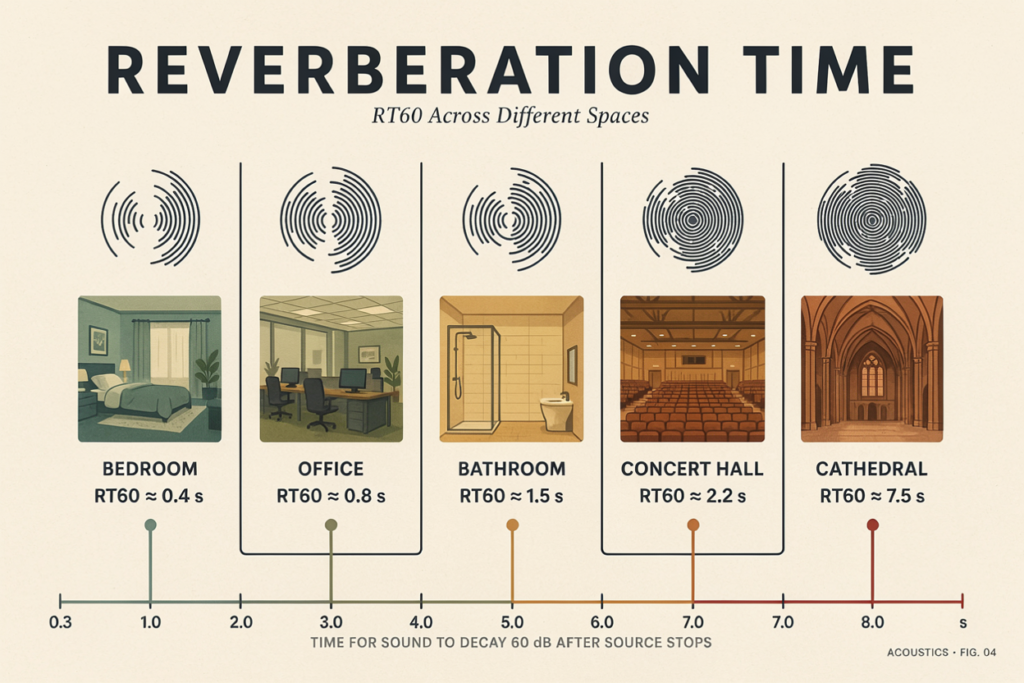
Reverberation time is the number of seconds sound takes to decay by 60 dB after its source stops. Usually written as RT60 or T60, it describes how long reflected sound remains in an enclosed space. The value changes with frequency, room volume, and the amount and placement of absorption.
Unlike a distinct echo, reverberation is made from many reflections arriving too closely together to hear separately. Understanding how reverb behaves in enclosed spaces helps explain why the same voice, instrument, or loudspeaker can sound clear in one room and blurred in another.
What Is Reverberation Time?
Reverberation time quantifies the decay of sound energy in a room. A room with an RT60 of 0.5 seconds takes half a second for its sound-pressure level to fall by 60 dB under the stated measurement conditions.
What does a 60 dB decay mean?
A 60 dB reduction means sound pressure falls to one-thousandth of its initial value. RT60 does not mean every reflection suddenly disappears then; it standardizes the room’s decay slope.
A direct 60 dB measurement often exceeds the usable range above background noise. Acousticians therefore measure part of the decay and extrapolate it.
What do short and long times sound like?
A short reverberation time usually produces tighter transients, clearer speech, and more separation between notes. A longer time creates more blend, sustain, and spaciousness, but too much decay can mask syllables and fast musical passages.
The suitable value depends on room volume and purpose. A voice booth, classroom, control room, and concert hall need different balances of clarity and envelopment. Published guidance on choosing an ideal RT60 is therefore use-specific, not universal.
Why Does Reverberation Time Matter?
Reverberation time affects speech intelligibility, musical definition, perceived room size, and listening comfort. It is one of the central room-acoustics measurements, but it must be considered alongside background noise, early reflections, frequency response, and spatial consistency.
Speech and critical listening
When a room decays too slowly, energy from one consonant or word overlaps the next. The listener may hear plenty of loudness but lose definition. Shorter decay generally supports speech, podcast recording, editing, and other tasks where detail matters.
Music and performance
Music often benefits from a longer decay because reflections connect notes and help performers hear an acoustic response. The desired amount depends on tempo, ensemble size, genre, and room volume. Fast rhythmic music usually tolerates less lingering energy than slow choral or orchestral material.
The broader room-acoustics guide explains why reverberation time alone cannot reveal flutter echoes, strong room modes, or an uneven stereo image.
What Is the Difference Between RT60, T20, T30, and EDT?
RT60 is the standardized 60 dB decay concept, while T20 and T30 estimate it from shorter measured ranges. EDT, or early decay time, describes the first 10 dB of decay extrapolated to 60 dB and often relates more closely to the listener’s initial impression of reverberance.
| Metric | Decay range commonly evaluated | Extrapolation | Practical meaning |
|---|---|---|---|
| RT60 or T60 | Full 60 dB in principle | None | Overall 60 dB decay time |
| T20 | Approximately −5 to −25 dB | Multiplied to a 60 dB equivalent | Useful when available dynamic range is limited |
| T30 | Approximately −5 to −35 dB | Multiplied to a 60 dB equivalent | Uses more of the decay and generally offers a stronger estimate when noise permits |
| EDT | 0 to approximately −10 dB | Multiplied to a 60 dB equivalent | Describes the early decay perceived soon after the source stops |
The first 5 dB is excluded from T20 and T30 fitting because the decay may not yet have a stable slope. EDT can differ when early and late decay rates are unequal. Always report the metric used.
How Is Reverberation Time Measured?
Reverberation time is measured by recording a room’s sound decay, plotting level against time, and fitting a line to a defined part of that decay. Professional assessment uses calibrated equipment, multiple source and microphone positions, and separate frequency bands.
Impulse response and interrupted noise
An impulse-response test plays a known signal and derives the room’s response. An interrupted-noise test excites the room with noise, stops the source, and records the decay.
A hand clap can reveal obvious ringing or flutter echo, but it is not a reference-grade RT measurement. Phone apps can be useful for rough comparisons when the setup stays unchanged, although microphone processing, limited low-frequency response, noise, and unknown calibration reduce confidence.
Frequency bands and positions
Reverberation time varies by frequency because materials do not absorb every band equally. Results are commonly examined in octave or one-third-octave bands rather than reduced to one broadband number. The relationship between material and frequency is clearer when you compare published sound-absorption coefficients.
Measure several positions because one point may sit near a room mode. Keep noise below the evaluated range, avoid clipping, and record whether the room is occupied.
How Do You Calculate Reverberation Time?
The Sabine equation estimates reverberation time from room volume and total equivalent absorption:
[
RT60 = \frac{0.161V}{A}
]
Here, (V) is volume in cubic metres and (A) is equivalent absorption area in square metres of sabins. Calculate (A) by adding each surface area multiplied by its absorption coefficient: (A=\sum S_i\alpha_i).
Worked Sabine example
Suppose a room has a volume of (100,m^3). Its floor, ceiling, walls, furnishings, and other contents provide a combined equivalent absorption area of 25 sabins:
[
RT60 = \frac{0.161 \times 100}{25} = 0.644\text{ seconds}
]
The predicted reverberation time is about 0.64 seconds for the frequency band represented by those absorption coefficients. Because coefficients change with frequency, the calculation should be repeated by band. A detailed Sabine formula walkthrough shows how individual surfaces contribute to the total.
When is Sabine not enough?
The Sabine model assumes a reasonably diffuse field and absorption that is not extremely high or uneven. It can diverge in small, irregular, coupled, or strongly modal rooms.
The Eyring model accounts differently for higher average absorption and may be more suitable in some rooms. Comparing the assumptions behind the Eyring reverberation equation prevents false precision. Either equation predicts behavior; an in-room measurement tests what actually happened.
What Controls a Room’s Reverberation Time?
Room volume and frequency-dependent absorption are the main controls. Larger volume generally lengthens decay when absorption stays constant, while more effective absorption shortens it.
Porous materials often absorb mids and highs more effectively than bass. Carpet may reduce brightness without fixing bass resonance, which usually needs thicker treatment.
Occupants, furnishings, openings, and treatment placement also change the result. Diffusion redistributes energy rather than removing it. Distinguish absorption from acoustic treatment as a whole.
How Can You Adjust Reverberation Time?
Adjust reverberation time by adding or removing effective absorption, changing its placement, and treating frequency ranges according to measured problems. The goal is a controlled, reasonably even decay—not simply the lowest possible number.
- Measure the untreated room at several positions and save results by frequency band.
- Define a target based on the room’s volume and intended use.
- Add broadband absorption at significant reflection areas.
- Address long low-frequency decay with sufficiently thick treatment.
- Re-measure using the same source, microphone positions, levels, and room condition.
- Compare band-by-band changes rather than relying on one average.
If highs become dry while bass rings, more thin foam will worsen the imbalance. A balanced home-studio acoustics plan combines decay control, placement, reflection management, and bass treatment.
Reverberation Time FAQ
Is reverberation time the same as RT60?
Reverberation time is the general property, while RT60 is its most common standardized expression: the time for a 60 dB decay. T20 and T30 are practical estimates of that same 60 dB value from shorter decay ranges.
Why are T20 and T30 used instead of measuring all 60 dB?
Many rooms do not provide a clean 60 dB decay before the signal reaches background noise. T20 and T30 fit a line to a usable portion of the decay and extrapolate the result, with T30 requiring more available dynamic range.
Does reverberation time change with frequency?
Yes. Surface materials, air, furnishings, and room modes affect frequency bands differently, so a room may decay quickly at high frequencies but slowly in the bass. A credible report identifies both the time metric and the frequency band.
Can a phone accurately measure reverberation time?
A phone can indicate broad before-and-after trends in a quiet room, but its microphone, automatic processing, speaker limitations, and lack of calibration restrict accuracy. Use a calibrated measurement system when compliance, design, or repeatable reference data matters.
How does adding absorption reduce reverberation time?
Absorption converts part of the reflected sound energy into heat instead of returning it to the room. Increasing equivalent absorption area makes the decay steeper and lowers the predicted RT60, provided the treatment is effective in the problem frequency range.

Noah Bennett is an audio engineering writer and acoustics specialist at Reverb Calculator. He focuses on reverb time calculation, room acoustics, studio sound design, and music production tools for producers, audio engineers, musicians, and home studio creators.