
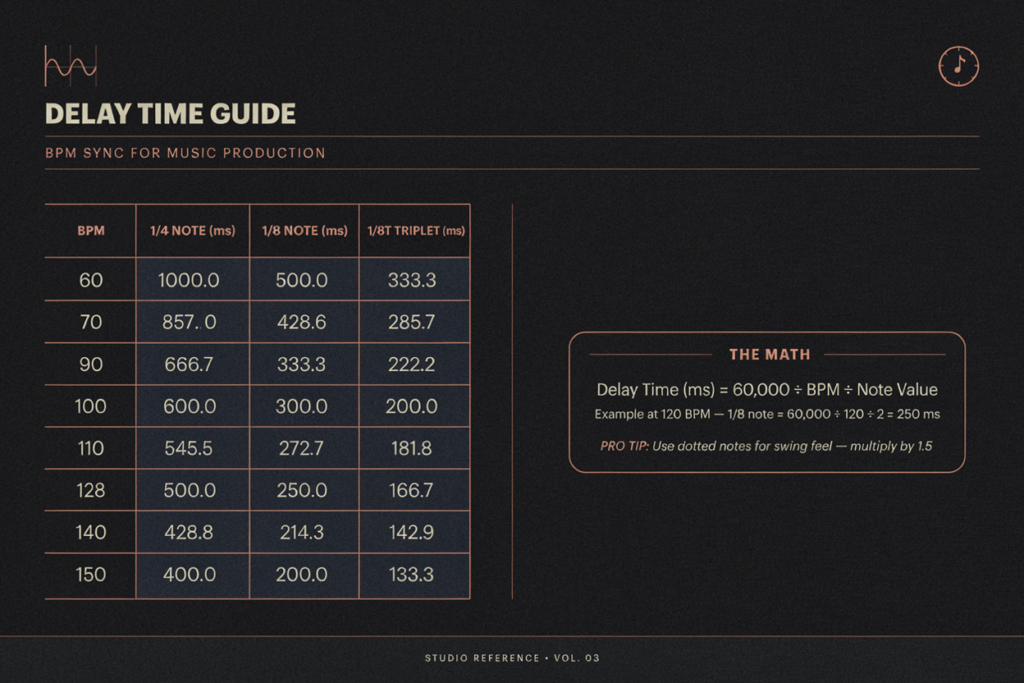
Delay time is the interval between an original sound and its echo. To calculate a quarter-note delay in milliseconds, divide 60,000 by the song’s BPM, then multiply or divide that result for straight, dotted, and triplet note values.
Choosing a delay that supports the groove takes more than matching a number. The right setting also depends on the source, feedback, filtering, arrangement, and whether you want an obvious rhythmic repeat or subtle thickening.
What Is Delay Time?
Delay time controls how long a delay effect waits before playing a copy of the input signal. Short values can create doubling or slapback; longer values produce distinct echoes that can form a rhythmic pattern.
Delay time, feedback, and mix are different controls
Delay time determines when each repeat occurs. Feedback sends some delayed audio back into the effect, determining how many repeats follow and how slowly they fade. The wet/dry mix or send level controls how loud those repeats are relative to the original.
Tempo-synced versus free-time delay
In sync mode, a DAW or pedal expresses time as note values such as 1/4, 1/8, or dotted 1/8 and follows the project tempo. In free-time mode, you enter milliseconds directly. Modern delay effects may also let you offset a synchronized repeat slightly ahead of or behind the exact grid.
Sync mode suits rhythmic echoes. Millisecond mode is useful for slapback, doubling, sound design, or a deliberately imperfect alignment. The same BPM-based approach also underpins tempo-synchronized reverb settings, although reverb calculations usually concern decay and pre-delay.
How Do You Calculate Delay Time From BPM?
Divide 60,000 by the tempo in beats per minute to find the duration of one quarter note:
Quarter-note delay (ms) = 60,000 ÷ BPM
Worked example at 120 BPM
At 120 BPM:
60,000 ÷ 120 = 500 ms
A quarter note therefore lasts 500 ms. From that value:
- Eighth note:
500 ÷ 2 = 250 ms - Sixteenth note:
500 ÷ 4 = 125 ms - Dotted eighth:
250 × 1.5 = 375 ms - Eighth-note triplet:
250 × 2 ÷ 3 ≈ 166.7 ms - Half note:
500 × 2 = 1,000 ms
Delay-time multipliers
Once you know the quarter-note duration, use these multipliers:
| Note value | Quarter-note multiplier | Time at 120 BPM |
|---|---|---|
| Whole note | 4 | 2,000 ms |
| Half note | 2 | 1,000 ms |
| Dotted quarter | 1.5 | 750 ms |
| Quarter note | 1 | 500 ms |
| Quarter-note triplet | 2/3 | 333.3 ms |
| Dotted eighth | 3/4 | 375 ms |
| Eighth note | 1/2 | 250 ms |
| Eighth-note triplet | 1/3 | 166.7 ms |
| Dotted sixteenth | 3/8 | 187.5 ms |
| Sixteenth note | 1/4 | 125 ms |
| Sixteenth-note triplet | 1/6 | 83.3 ms |
Round only as much as the device requires: a whole-millisecond display would use 167 ms for the eighth-note triplet. A BPM guide by musical genre provides useful tempo context without turning conventions into rules.
How Do Straight, Dotted, and Triplet Delays Differ?
Straight delays reinforce the beat, dotted delays create syncopation, and triplet delays divide beats into three-part patterns.
Straight notes create a predictable pulse
Quarter- and eighth-note repeats align with familiar grid positions. Quarter notes leave more space; eighth notes feel busier and remain predictable in dense arrangements.
Dotted notes create syncopated movement
A dotted note lasts 1.5 times the matching straight note. A dotted eighth equals three sixteenth notes, creating a propulsive pattern when the original part leaves space.
Triplets create rolling subdivisions
An eighth-note triplet is one-third of a quarter-note beat; a quarter-note triplet is two-thirds. Triplet delays complement shuffle, swing, and compound-meter phrasing, but let the performance guide the choice.
Which Delay Time Should You Choose?
Choose delay time by the role the repeat should play. Use short milliseconds for width or vintage-style slapback, subdivisions for rhythmic interaction, and longer values for exposed atmospheric echoes.
| Purpose | Practical starting point | What to listen for |
| Subtle doubling | About 15–40 ms | Added width without a separate echo |
| Slapback | About 60–180 ms, low or zero feedback | One audible bounce behind the source |
| Fast rhythmic detail | Straight or dotted 1/16 | Motion without covering the next phrase |
| Syncopated pattern | Dotted 1/8 | Repeats filling spaces between played notes |
| Clear pulse | Straight 1/8 or 1/4 | Repeats reinforcing the groove |
| Rolling feel | 1/8- or 1/4-note triplet | Three-part movement against the beat |
| Spacious throws | 1/4, 1/2, or longer | Distinct echoes in arrangement gaps |
These are starting points, not presets. Vocals tolerate longer filtered repeats when delay is automated at phrase endings; this guide to using reverb with vocals offers related clarity techniques. Guitar may suit slapback, dotted eighths, or stereo echoes depending on articulation, as explained in this guide to spatial effects for guitar.
How Do You Set Delay Time in a DAW or Pedal?
Set the tempo, choose sync or millisecond mode, select a note value or time, and adjust with the full arrangement playing.
- Confirm the project BPM or use tap tempo while listening to the track.
- Choose sync mode for musical subdivisions or time mode for a millisecond value.
- Start with an eighth note, quarter note, or dotted eighth for rhythmic delay.
- Lower feedback until the repeats stop before they interfere with the next phrase.
- Set the wet level quietly, then raise it until the rhythm becomes useful.
- Nudge the time or timing offset if an exact grid value feels stiff.
A delay inserted on a track uses dry/wet control. On an aux return, set it fully wet and blend with the send. This resembles common DAW reverb routing and lets tracks share an effect. When using tap tempo, tap several steady quarter notes and verify the result against a stable rhythmic reference.
How Do You Keep Delay From Cluttering a Mix?
Reduce feedback and return level, then filter frequencies competing with the dry source. Repeats usually need less low end and high-frequency detail than the original.
High-pass filtering removes buildup; low-pass filtering pushes repeats behind lead sounds. Ducking lowers delay while the dry source plays, and automation can activate long throws only on selected notes.
Stereo or ping-pong delay creates separation, but check mono because left/right timing or modulation may change apparent level. Related priorities appear in this guide to mixing ambience cleanly.
Why Doesn’t the Delay Feel in Time?
A mathematically correct delay can still conflict with the performance, especially when later feedback repeats cross phrase boundaries.
| Problem | Likely cause | Practical fix |
| Repeats drift from the track | Incorrect BPM or an unsynced tempo change | Verify the tempo map or automate delay time |
| Dotted rhythm sounds unexpected | Dotted and triplet values were confused | Recheck the multiplier and plugin notation |
| Echoes are technically aligned but stiff | Performance sits ahead of or behind the grid | Apply a small offset by ear |
| Words or notes become unclear | Feedback, wet level, or delay length is too high | Shorten the pattern and reduce repeats |
| Low end becomes blurry | Full-range repeats overlap bass and kick | High-pass the delay return |
| Tempo change causes a pitch sweep | Delay time changes continuously | Use a mode designed for clean sync changes or automate carefully |
Delay creates recognizable repeats; pre-delay creates a gap before reverb begins. This explanation of how pre-delay affects clarity shows why similar millisecond values serve different purposes.
Delay Time FAQ
What is the formula for converting BPM to milliseconds?
Divide 60,000 by BPM for a quarter note in milliseconds. Multiply by 0.5 for an eighth, 0.75 for a dotted eighth, or one-third for an eighth-note triplet.
What is the delay time for 120 BPM?
At 120 BPM, a quarter is 500 ms, an eighth 250 ms, and a sixteenth 125 ms. A dotted eighth is 375 ms; an eighth-note triplet is about 166.7 ms.
Should delay always be synchronized to the song tempo?
No. Tempo sync helps rhythmic repeats, but doubling, slapback, and sound design often suit free millisecond values. A small offset can make synchronized delay feel less rigid.
What delay time creates a slapback echo?
Slapback commonly uses one repeat around 60–180 ms with little or no feedback. The best time depends on tempo, articulation, and desired audibility.
Does time signature change the delay-time formula?
The formula remains 60,000 ÷ BPM when the beat unit is a quarter note. Time signature changes beat grouping, so it affects which subdivision suits the groove.
Can delay and reverb use the same rhythmic timing?
Yes, but timing serves different roles. Delay places distinct repeats on a grid, while reverb uses tempo relationships for pre-delay or decay; reverb in music production explains how both create depth differently.

Noah Bennett is an audio engineering writer and acoustics specialist at Reverb Calculator. He focuses on reverb time calculation, room acoustics, studio sound design, and music production tools for producers, audio engineers, musicians, and home studio creators.