
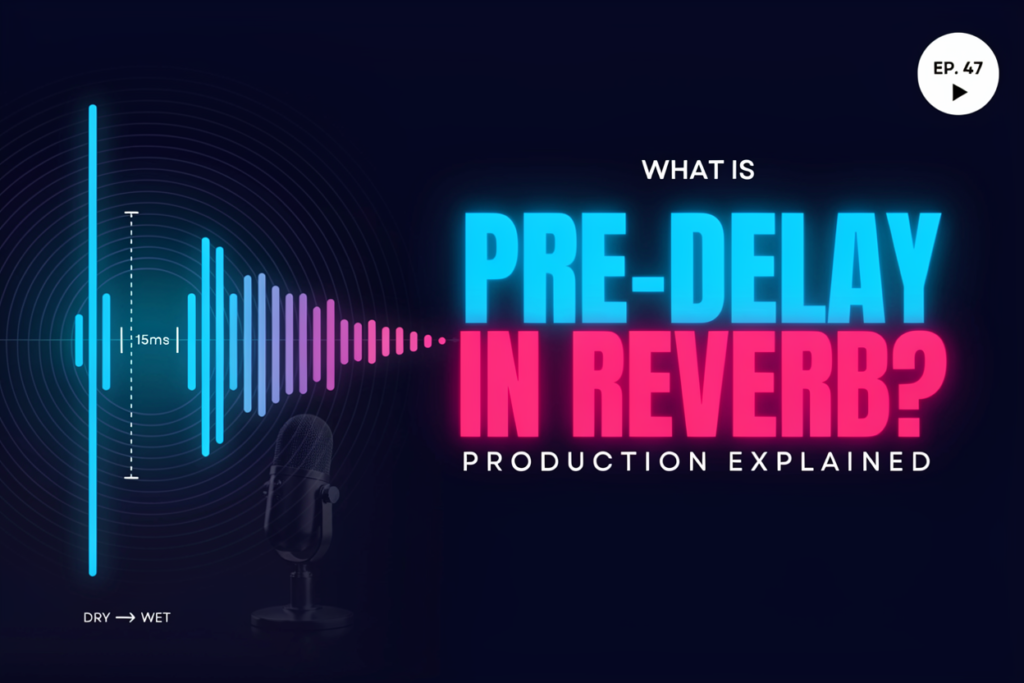
Reverb pre-delay is the time between the original dry sound and the beginning of its reverberant response. A short pre-delay blends the source into the simulated space, while a longer setting separates the attack from the reverb and can improve clarity or make the source seem closer.
Measured in milliseconds, pre-delay controls when reflections begin—not how long they continue. As explained in how reverberation works, it can change depth without altering decay time.
What Is Pre-Delay in Reverb?
Pre-delay in reverb is an initial pause between a dry signal and the onset of the reverb generated from it. In many processors, the setting delays the entire reverberant response; in others, it specifically controls the time before the first early reflections.
Ableton’s Live manual defines pre-delay as the delay before the first early reflection and identifies roughly 1–25 ms as typical for natural-sounding spaces. Longer values can create stronger separation or a rhythmic effect.
Where Does Pre-Delay Sit in the Signal Path?
A simplified signal path looks like this:
Dry sound → pre-delay interval → early reflections → diffuse reverb tail
The dry sound is heard first. Early reflections then suggest the space, followed by a dense tail. Pre-delay moves that response without necessarily changing its duration.
Why Do Plugin Definitions Differ?
Reverb processors divide their signal paths differently. One may delay both early reflections and the late tail; another may provide separate timing controls.
What Does Reverb Pre-Delay Do to a Sound?
Pre-delay changes the separation between the source and its simulated environment. Short values make the direct sound and reflections fuse quickly; longer values leave more unprocessed attack audible before the reverberation arrives.
How Does Short Pre-Delay Affect the Source?
At very short settings, reverb begins almost immediately. This can make a source feel embedded in the room and may work well for subtle ambience or sounds that should sit farther back.
Too little separation can soften consonants, drum hits, and other fast transients. If the reverb masks each note’s start, increase the setting gradually.
Why Can Longer Pre-Delay Improve Clarity?
Longer pre-delay gives the initial attack a brief uncluttered window. That separation can keep a vocal intelligible or preserve the impact of a snare while still allowing a substantial tail afterward.
This is useful when mixing reverb around a dense arrangement. The source can remain forward without removing or dramatically shortening the reverb.
When Does Pre-Delay Start to Sound Like an Echo?
An extended gap can make reverb a separate event. The threshold depends on the source envelope, tempo, decay, reflection pattern, and wet level. Percussion reveals it more readily than a slow pad.
If the tail sounds detached or slap-like, shorten the pre-delay or lower the early-reflection level. Compare it in the full arrangement because a gap heard in solo may disappear in context.
How Is Pre-Delay Different From Decay Time, Room Size, and Delay?
Pre-delay determines when reverb starts. Decay time determines how long it takes to fade, room size changes the model’s spatial characteristics, and a conventional delay creates one or more distinct repeats.
| Control | What it changes | Typical unit | Main audible result |
|---|---|---|---|
| Pre-delay | Time before reverb begins | ms | Separation between attack and space |
| Decay time | Duration of the fading tail | seconds | Length and sustain |
| Room size | Dimensions or timing relationships in the model | %, category, or arbitrary value | Apparent scale and reflection pattern |
| Audio delay | Time before a repeated copy of the source | ms or note value | Distinct repeat or rhythmic echo |
Pre-delay does not normally create feedback repeats. When comparing reverb and delay as separate effects, reverb builds a dense reflection field while delay preserves recognizable repetitions.
Room size and decay are also not interchangeable. A compact reflective room can have a noticeable tail, while a larger treated room may decay quickly.
How Much Pre-Delay Should You Use?
Use the smallest value that creates the depth or clarity the track needs. Natural spaces often suggest short settings, but source attack, arrangement density, tempo, and creative intent matter more than an isolated preset number.
| Application | Practical starting range | What to listen for |
| Tight ambience | 0–10 ms | Immediate blend without obvious separation |
| Natural room effect | 5–25 ms | Cohesion with recognizable early reflections |
| Lead vocal | 20–60 ms | Clear words before the tail arrives |
| Snare or percussion | 10–40 ms | Preserved impact without a detached slap |
| Guitar or piano | 10–40 ms | Note definition and believable depth |
| Creative rhythmic effect | 40–150+ ms | Intentional gap or pulse |
These ranges are starting points. For vocals, adjust pre-delay alongside techniques for balancing reverb around vocal intelligibility. On percussion, let the attack and groove guide the settings described in using reverb on drums.
Why Is There No Universal Best Setting?
The same 30 ms value differs by source. A fast snare exposes the interval, while a bowed string or pad may still be swelling when the reverb begins. A high wet level also emphasizes the onset.
Room model matters too. Dense early reflections fill the gap differently from a sparse algorithm. For a compact acoustic impression, consider how pre-delay interacts with the early reflections and scale of room reverb.
How Do You Sync Reverb Pre-Delay to Tempo?
To synchronize pre-delay, calculate the duration of a beat and divide it into smaller note values. Use 60,000 ÷ BPM to find the length of one quarter note in milliseconds.
At 120 BPM:
| Note value | Calculation | Duration |
| Quarter note | 60,000 ÷ 120 | 500 ms |
| Eighth note | 500 ÷ 2 | 250 ms |
| Sixteenth note | 500 ÷ 4 | 125 ms |
| Thirty-second note | 500 ÷ 8 | 62.5 ms |
| Sixty-fourth note | 500 ÷ 16 | 31.25 ms |
Smaller subdivisions are usually more practical for natural separation. Larger values produce a pronounced rhythmic gap. A tempo-based delay time guide can help calculate dotted and triplet values.
Tempo synchronization is optional. An exact value may not fit a vocal phrase or drum envelope, so adjust by ear after calculating a starting point. The same principle applies when matching reverb timing to BPM.
How Do You Set Pre-Delay Without Detaching the Reverb?
Set pre-delay by listening for the point where the source becomes clear but the tail still feels connected. A short four-step method works across vocals, drums, guitars, and keys:
- Start near 0 ms with the decay and wet level already close to their intended settings.
- Increase pre-delay slowly until the attack, consonants, or note definition become easier to hear.
- Continue until the gap begins to resemble a slap, then back the setting down.
- Recheck the wet level, decay, and EQ in the full mix rather than judging the control in solo.
If clarity does not improve, shorten the tail, reduce the send, filter troublesome wet frequencies, or choose a less dense reverb. Pre-delay cannot correct every form of masking.
Frequently Asked Questions About Reverb Pre-Delay
Is reverb pre-delay the same as audio delay?
No. Pre-delay postpones the onset of a reverberant response, while an audio delay usually creates a recognizable copy or series of repeats. A long pre-delay can resemble a slap, but it still feeds into a reverb tail.
Does longer pre-delay make a sound feel closer or farther away?
Longer pre-delay often makes the dry source feel closer because its attack arrives clearly before the reflections. Perceived distance also depends on the dry-to-wet balance, early-reflection level, tone, and overall loudness, so pre-delay alone does not determine position.
What is a good pre-delay setting for vocals?
About 20–60 ms is a useful starting range for many lead vocals because it can preserve consonants before the reverb arrives. The best value depends on the singer’s phrasing, song tempo, reverb density, and desired depth.
Should drum reverb use pre-delay?
Drum reverb can use pre-delay when the dry hit needs to retain punch. Start around 10–40 ms, then shorten it if the ambience feels detached or lengthen it slightly if the transient is being blurred.
Should pre-delay be synchronized to the song tempo?
Tempo synchronization can make the reverb onset relate rhythmically to the groove, especially with longer or creative settings. It is optional for short, natural pre-delay, where adjusting by ear may sound more convincing.
Can too much pre-delay make reverb sound unnatural?
Yes. Excessive pre-delay can expose a gap between the source and reflections, making the reverb sound like a separate echo. Reduce the time until the response reconnects with the dry sound, then reassess it in the complete mix.

Noah Bennett is an audio engineering writer and acoustics specialist at Reverb Calculator. He focuses on reverb time calculation, room acoustics, studio sound design, and music production tools for producers, audio engineers, musicians, and home studio creators.