
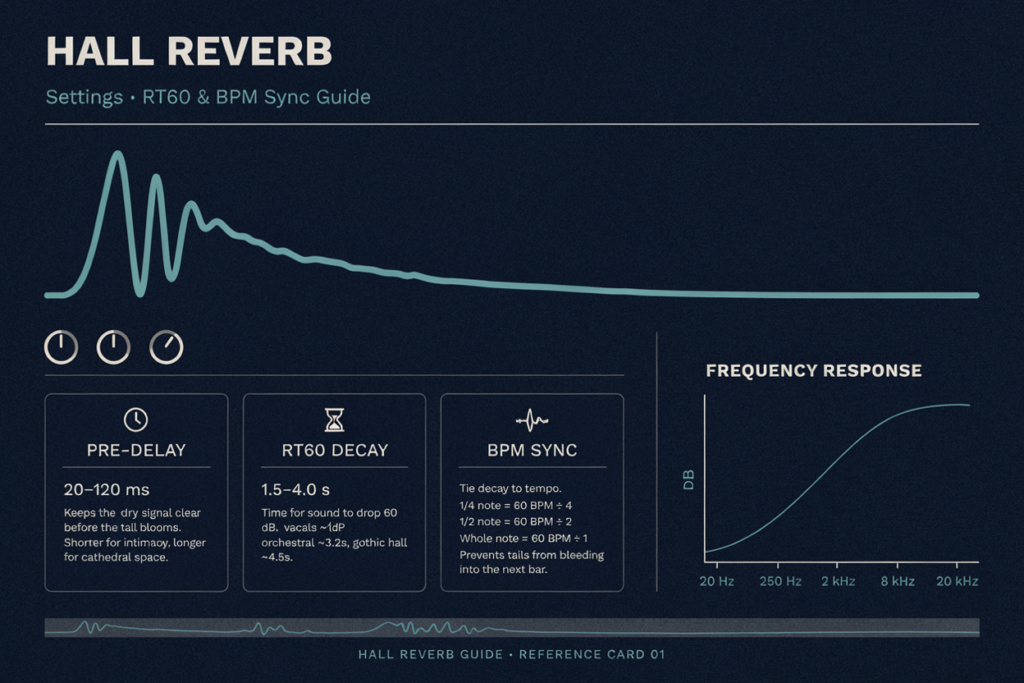
Hall reverb is a type of reverb effect that recreates the spacious sound of large acoustic environments such as concert halls, theaters, and performance spaces. It adds depth, width, and emotion to audio by simulating the way sound waves reflect and decay inside a large room.
Unlike room reverb, which creates a smaller and more intimate atmosphere, hall reverb produces a much larger sense of space with longer reflections and extended reverb tails.
Hall reverb is widely used in music production for vocals, orchestral instruments, piano, cinematic soundtracks, and ambient music because it can make sounds feel more dramatic and immersive.
The key to using hall reverb effectively is balance. A large space can create beautiful depth, but too much can make a mix sound distant, unclear, and washed out.
What Is Hall Reverb?
Hall reverb is a reverb effect designed to imitate the acoustic characteristics of a large hall.
In a real concert hall, sound travels through a large space and reflects from:
- Walls
- Ceilings
- Floors
- Other surfaces
These reflections create a sense of:
- Size
- Distance
- Depth
- Atmosphere
Hall reverb recreates these characteristics digitally using algorithms or recorded acoustic measurements.
Common hall simulations include:
- Concert halls
- Opera halls
- Large performance spaces
- Cathedral-like environments
Because of its large scale, hall reverb is often used when a production needs a more emotional or cinematic feeling.
How Hall Reverb Works
The sound of hall reverb comes from several stages of acoustic reflection.
The basic process is:
Original Sound → Early Reflections → Diffusion → Reverb Tail → Final Output
Direct Sound
The direct sound is the original audio signal before any reflections occur.
It determines:
- Clarity
- Presence
- Position of the instrument
Early Reflections
Early reflections are the first sounds that bounce back from nearby surfaces.
They help create the perception of:
- Room size
- Distance
- Location
In a large hall, these reflections arrive later compared with a small room.
Diffusion
Diffusion controls how reflections spread and blend together.
Higher diffusion creates:
- Smooth reverb
- Dense atmosphere
- Natural-sounding tails
Lower diffusion creates:
- More noticeable reflections
- A less blended effect
Reverb Tail
The reverb tail is the long decay that follows the original sound.
Hall reverb usually has a longer tail than room reverb because large spaces take more time for sound energy to disappear.
Hall Reverb vs Other Reverb Types
Different reverb types create different emotional effects.
| Feature | Hall Reverb | Room Reverb | Plate Reverb |
|---|---|---|---|
| Character | Large and spacious | Natural and intimate | Smooth and polished |
| Space Size | Large | Small-medium | Artificial studio effect |
| Decay | Long | Short-medium | Medium-long |
| Common Uses | Vocals, strings, cinematic music | Drums, instruments | Vocals, leads |
Hall Reverb vs Room Reverb
Room reverb creates the feeling of a smaller physical space.
It works well for:
- Drums
- Acoustic instruments
- Natural recordings
Hall reverb creates a larger environment.
It works well for:
- Emotional vocals
- Orchestral music
- Cinematic sound design
You can learn more about smaller acoustic spaces in this guide to room reverb.
Hall Reverb vs Plate Reverb
Plate reverb creates a smooth, dense, studio-style effect.
Hall reverb creates a more realistic feeling of distance and space.
Plate reverb is commonly used for:
- Lead vocals
- Snare drums
- Studio recordings
Hall reverb is commonly used for:
- Large arrangements
- Ambient sounds
- Cinematic productions
You can explore more about plate-based effects in this guide to plate reverb.
Best Hall Reverb Settings
Hall reverb settings depend on the instrument and style, but these values provide a useful starting point.
| Parameter | Starting Point |
|---|---|
| Decay Time | 2–6 seconds |
| Pre-Delay | 30–100 ms |
| Wet Mix | 10–30% |
| Diffusion | Medium-high |
| High-Pass Filter | 100–300 Hz |
Decay Time
Decay controls how long the hall ambience continues.
Shorter decay:
- Keeps the mix cleaner
- Works better for faster songs
- Adds moderate depth
Longer decay:
- Creates cinematic space
- Adds emotion
- Works well for slow music
Large decay times should be used carefully because they can quickly fill the mix.
Pre-Delay
Pre-delay creates a gap between the original sound and the beginning of the reverb.
This helps maintain clarity.
Common settings:
- 30–50 ms for moderate separation
- 50–100 ms for large vocal spaces
A longer pre-delay allows vocals and instruments to stay closer while the hall appears behind them.
Wet/Dry Mix
The wet mix determines how much hall effect is added.
Lower settings:
- Add subtle depth
- Maintain clarity
Higher settings:
- Create dramatic ambience
- Push sounds further into the space
For most mixes, hall reverb works best as a supporting element rather than the dominant sound.
Using Hall Reverb in Music Production
Hall Reverb for Vocals
Hall reverb can make vocals feel emotional and expansive.
It works especially well for:
- Ballads
- Cinematic vocals
- Powerful chorus sections
A typical vocal hall setup:
- Medium decay
- Moderate pre-delay
- Controlled wet mix
However, very long hall reverbs can reduce vocal clarity if not carefully balanced.
For more vocal-specific approaches, see this guide on reverb for vocals.
Hall Reverb for Piano
Piano often benefits from hall reverb because it naturally fits large acoustic environments.
It can create:
- Emotional depth
- Concert-like atmosphere
- Cinematic character
A subtle hall can make digital piano recordings feel more realistic.
Hall Reverb for Strings and Orchestral Music
Hall reverb is one of the most common choices for orchestral instruments.
It helps create:
- Natural ensemble space
- Musical cohesion
- Grand atmosphere
Strings, choirs, and orchestral sections often sound more convincing inside a large simulated hall.
Hall Reverb for Synth Pads
Electronic music frequently uses hall reverb on pads and atmospheric sounds.
It can create:
- Wide soundscapes
- Dreamy backgrounds
- Expansive textures
Hall Reverb for Guitar
Hall reverb can add depth to guitar recordings, especially:
- Clean electric guitar
- Ambient guitar
- Post-rock styles
It creates a larger emotional space than small room effects.
Hall Reverb for Cinematic Music
Hall reverb is essential in cinematic production because large spaces help create emotion and scale.
It is often used for:
- Film scores
- Trailers
- Sound design
- Ambient compositions
Large halls can make simple sounds feel dramatic and powerful.
How to Use Hall Reverb Without Losing Clarity
Use EQ Filtering
Hall reverbs can create frequency buildup.
Common adjustments:
- Remove low frequencies from the reverb return
- Reduce harsh high frequencies
This keeps the mix cleaner.
Use Pre-Delay
Increasing pre-delay allows the original sound to remain clear before the hall effect appears.
Automate the Reverb
Instead of keeping the same amount throughout a song:
- Increase reverb during choruses
- Reduce it during verses
- Add larger spaces during transitions
Use It as a Send Effect
A separate reverb bus provides:
- Better control
- Cleaner mixing
- Easier adjustments
For more techniques, see this guide on mixing reverb.
Common Hall Reverb Mistakes and Fixes
Too Much Decay
Problem: The mix becomes muddy.
Fix: Reduce decay time.
Vocals Sound Too Far Away
Problem: The singer loses presence.
Fix: Increase pre-delay and lower the wet mix.
Low-End Build-Up
Problem: The reverb competes with bass instruments.
Fix: Apply high-pass filtering.
Every Instrument Uses Large Reverb
Problem: The entire mix loses focus.
Fix: Use hall reverb selectively.
Frequently Asked Questions
What is hall reverb used for?
Hall reverb is used to create large, spacious environments for vocals, piano, strings, guitars, synths, and cinematic productions.
What is the difference between hall and room reverb?
Hall reverb creates a large, spacious environment with longer decay, while room reverb creates a smaller and more intimate acoustic space.
Is hall reverb good for vocals?
Yes. Hall reverb can make vocals sound emotional and expansive, especially in ballads and cinematic music.
What are good hall reverb settings?
A good starting point is 2–6 seconds decay, 30–100 ms pre-delay, and 10–30% wet mix.
Why does hall reverb sound so spacious?
Hall reverb sounds spacious because it simulates the long reflections and extended decay found in large acoustic environments.

Noah Bennett is an audio engineering writer and acoustics specialist at Reverb Calculator. He focuses on reverb time calculation, room acoustics, studio sound design, and music production tools for producers, audio engineers, musicians, and home studio creators.