
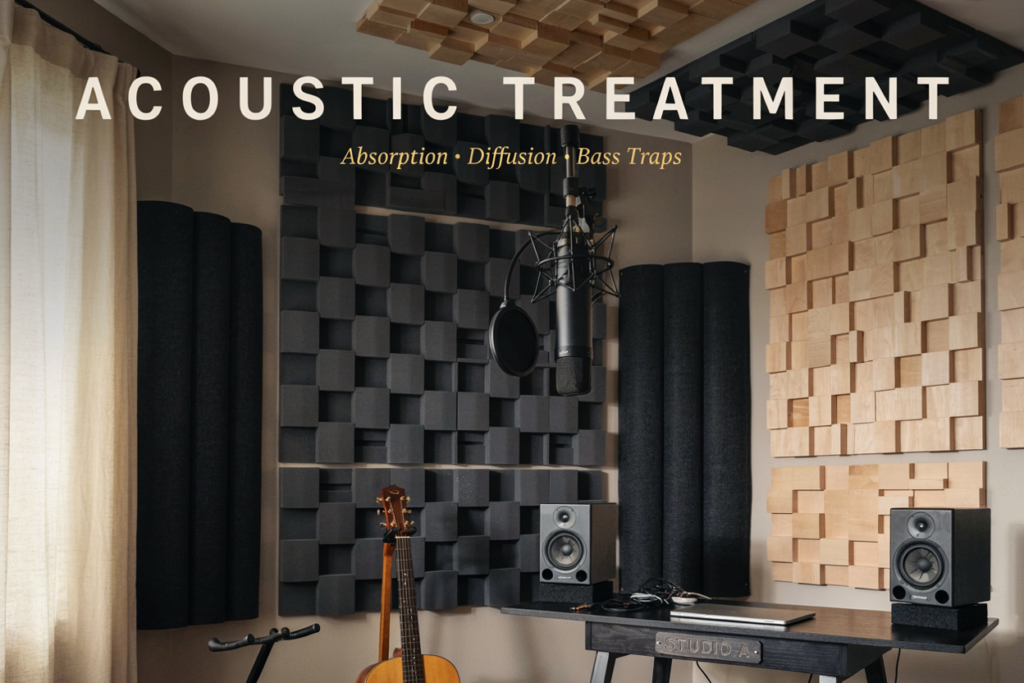
Acoustic treatment improves the sound inside a room by controlling unwanted reflections, echoes, and frequency problems. It helps recording studios, home studios, and listening spaces produce a more accurate sound by reducing acoustic issues that affect recording, mixing, and monitoring.
Many people confuse acoustic treatment with soundproofing, but they solve different problems. Acoustic treatment improves how sound behaves inside a room, while soundproofing prevents sound from entering or leaving a space.
A properly treated room does not necessarily become quieter from outside noise, but it allows you to hear recordings and mixes more clearly and make better audio decisions.
What Is Acoustic Treatment?
Acoustic treatment is the process of placing materials and structures inside a room to control sound reflections and improve acoustic balance.
When sound leaves a speaker or a singer’s mouth, it travels directly to the listener but also reflects from walls, ceilings, floors, and furniture. These reflections can create problems such as:
- Echo and unwanted ambience
- Muddy low frequencies
- Poor stereo imaging
- Inaccurate mixing decisions
- Uneven frequency response
Acoustic treatment manages these problems by absorbing, diffusing, or controlling sound energy.
A well-treated room allows you to hear the original sound more accurately instead of hearing a mixture of direct sound and unwanted reflections.
Acoustic Treatment vs Soundproofing
Although the terms are often used together, acoustic treatment and soundproofing have different goals.
| Feature | Acoustic Treatment | Soundproofing |
|---|---|---|
| Main purpose | Improve sound quality inside a room | Reduce sound transfer between spaces |
| Controls | Reflections, echo, frequency balance | Noise entering or leaving a room |
| Common materials | Acoustic panels, bass traps, diffusers | Mass-loaded materials, insulation, sealed structures |
| Used for | Recording, mixing, listening accuracy | Privacy and noise isolation |
For example, installing acoustic panels can reduce echo in a recording room, but it will not stop traffic noise from entering through a window.
Why Acoustic Treatment Matters for Recording and Mixing
A room affects every sound you record or mix. Even expensive microphones, speakers, and headphones cannot completely solve problems caused by poor room acoustics.
Without treatment, common issues include:
- Early reflections: Sound bouncing from nearby surfaces and reaching your ears shortly after the direct sound.
- Room modes: Low-frequency buildup caused by room dimensions.
- Excessive reverberation: Too much reflected sound making recordings unclear.
For vocal recording, uncontrolled reflections can make a voice sound distant or boxy. For mixing, inaccurate bass response can cause producers to add too much or too little low-end.
Acoustic treatment helps create a more reliable listening environment.
Main Types of Acoustic Treatment
Different acoustic problems require different solutions. The three main types of treatment are absorption, bass control, and diffusion.
Absorption Panels
Absorption panels reduce unwanted reflections by converting some sound energy into heat.
They are commonly used to control:
- Vocal recording reflections
- Wall reflections
- High and mid-frequency problems
- Excessive room brightness
Acoustic panels are usually placed at reflection points, such as the side walls near studio monitors and behind recording areas.
For detailed guidance on panel selection and placement, see our guide on acoustic panels.
Bass Traps
Low frequencies are among the most difficult problems to control because bass wavelengths are long and can build up in room corners.
Bass traps help manage:
- Boomy bass
- Uneven low-frequency response
- Room resonance problems
They are commonly installed in corners where low-frequency energy accumulates.
Learn more about managing low frequencies with bass traps.
Acoustic Diffusers
Diffusers scatter sound reflections in different directions instead of absorbing them completely.
They are useful when a room sounds:
- Too flat after heavy absorption
- Unnaturally dry
- Lacking natural spaciousness
Diffusion is often used in larger studios, listening rooms, and professional environments.
You can explore how diffusion works in our acoustic diffusers guide.
How to Treat a Room Step by Step
1. Identify the Room Problems
Before buying treatment, understand what problems exist.
Listen for:
- Echo after clapping
- Boomy bass
- Uneven volume between locations
- Harsh reflections
Understanding your room’s behavior is the first step toward effective treatment.
For a deeper introduction to room behavior, read our room acoustics guide.
2. Improve the Listening Position
The position of your speakers and listening area strongly affects what you hear.
Avoid placing speakers directly against walls or sitting in areas where strong reflections create inaccurate sound.
A balanced listening position allows acoustic treatment to work more effectively.
3. Control Early Reflections
Early reflections from side walls, ceilings, and nearby surfaces can interfere with the direct sound.
Adding absorption at these reflection points improves:
- Stereo clarity
- Vocal recordings
- Instrument separation
4. Manage Low Frequencies
After controlling reflections, address bass problems.
Low-frequency issues often require:
- Proper speaker placement
- Bass traps
- Room measurement
Simply adding more foam or thin panels usually does not solve bass problems.
5. Add Diffusion When Needed
Once major problems are controlled, diffusion can help maintain a natural and balanced room sound.
The goal is not to remove all reflections but to create controlled reflections.
Common Acoustic Treatment Mistakes
Treating Only High Frequencies
Many beginners install thin foam panels that reduce high frequencies but leave bass problems untouched.
A balanced approach should consider the entire frequency range.
Covering Every Wall With Panels
More treatment is not always better. Excessive absorption can make a room sound unnatural and overly dry.
Ignoring Room Layout
Even expensive acoustic products cannot fully compensate for poor speaker placement or an unsuitable listening position.
Confusing Treatment With Soundproofing
Acoustic panels improve internal sound quality but do not block outside noise.
How Much Acoustic Treatment Does a Room Need?
The amount of treatment depends on:
- Room size
- Room shape
- Intended use
- Speaker placement
- Existing furniture and materials
A small home studio may only need strategic placement of absorption panels and bass traps, while a professional recording studio may require detailed acoustic planning.
For advanced room evaluation, factors such as reverberation time (RT60) are important. You can learn more about this measurement in our guide to RT60.
Frequently Asked Questions
What does acoustic treatment do?
Acoustic treatment controls unwanted reflections, echoes, and frequency problems to improve sound accuracy inside a room.
Does acoustic treatment make a room soundproof?
No. Acoustic treatment improves internal sound quality, while soundproofing reduces sound transmission between spaces.
Are acoustic panels enough for a studio?
Not always. Panels help with reflections, but low frequencies may require bass traps and other solutions.
Where should acoustic panels be placed?
Panels are commonly placed at early reflection points, such as side walls and areas around the listening position.
Do small rooms need acoustic treatment?
Yes. Small rooms often have stronger acoustic problems because reflections and low-frequency buildup can become more noticeable.

Noah Bennett is an audio engineering writer and acoustics specialist at Reverb Calculator. He focuses on reverb time calculation, room acoustics, studio sound design, and music production tools for producers, audio engineers, musicians, and home studio creators.