
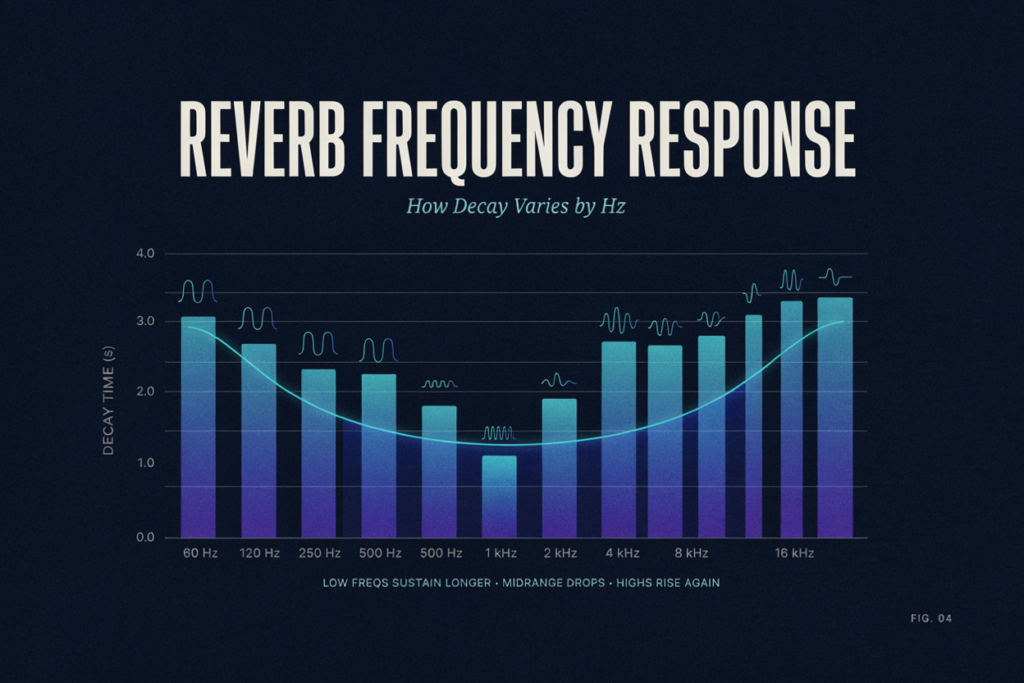
Reverb frequency response is the balance of low, mid, and high frequencies in a reverberant signal. It determines whether the reverb sounds dark, bright, warm, thin, boomy, or metallic. Producers shape that balance with filtering and EQ, while damping controls how quickly different frequency bands fade during the tail.
What Is Reverb Frequency Response?
Reverb frequency response describes how much energy the reverberant signal contains at each frequency. If the return has excessive low-mid energy, it may sound cloudy. If its upper mids and highs are too prominent, the tail may sound harsh, fizzy, or unnaturally bright.
In a physical room, dimensions, surfaces, furnishings, and air absorption shape the spectrum. A digital reverb creates a spectral balance algorithmically or captures one in an impulse response. The dry source also matters: a dark reverb may balance a bright vocal but dull an already muted piano. There is no universally correct curve; the useful response supports the arrangement without masking it. This guide to reverb in music production explains how space, reflections, and decay interact.
Why reverb sounds bright, dark, warm, or boomy
A bright reverb retains noticeable upper-frequency energy. A dark reverb has less high-frequency content or loses it more quickly. Warmth usually suggests controlled highs with supportive low-mid energy, while boominess points to excessive or prolonged bass energy.
How Is Reverb Frequency Response Different From Damping?
Output EQ changes the level of frequency bands in the complete wet signal. Damping changes how quickly selected frequencies decay. Input filtering controls which parts of the dry source enter the reverb in the first place.
| Control | What it changes | What you hear | Common use |
|---|---|---|---|
| Input filter | Frequencies feeding the reverb | Less low-end or high-end energy excites the effect | Prevent rumble, sibilance, or pick noise from generating a long tail |
| Output EQ | Final tonal balance of the wet return | A frequency band becomes louder or quieter throughout the return | Reduce masking or fit the return around the dry source |
| Damping | Decay rate by frequency | Selected frequencies disappear sooner or remain longer | Make the tail darker, smoother, or more physically believable |
| Frequency-dependent decay | Reverb time within defined bands | Bass, mids, and highs sustain for different lengths | Correct low-end overhang or shorten bright tails without lowering their initial presence |
Why a high-frequency EQ cut is not the same as damping
Imagine a vocal reverb whose top end is clear at the start but distractingly bright near the end of every phrase. A high-shelf cut lowers those frequencies in the early reflections and the tail. Stronger high-frequency damping can preserve some initial brightness while making the highs fade sooner.
That time-dependent change can feel more natural because real spaces rarely sustain every frequency equally. This explanation of reverberation time and decay covers the underlying timing concepts.
Why Do Different Frequencies Decay at Different Rates?
Different frequencies decay at different rates because air, surfaces, furnishings, and room modes do not absorb or reinforce all frequencies equally. High frequencies are commonly absorbed more strongly, while low frequencies may remain active when a room lacks effective bass control.
Air and surface absorption
Soft and porous materials tend to absorb more mid- and high-frequency energy than deep bass. Air absorption also affects highs more strongly over long distances, helping large spaces develop darker tails. Comparing absorption coefficients across frequency bands shows why materials influence a room differently.
Low-frequency buildup and room modes
Low-frequency wavelengths interact strongly with room dimensions. Reflections can reinforce or cancel frequencies, creating room modes and uneven decay. Treatment aimed only at early reflections may not solve the resulting overhang; low-frequency bass trapping is generally deeper than thin absorptive panels.
Why RT60 is measured by frequency band
RT60 is the estimated time required for sound level in a room to fall by 60 dB after the source stops. Acoustic measurements commonly report it in octave or one-third-octave bands because one broadband value can hide serious differences between bass, midrange, and treble decay.
Averaging only midrange bands could hide a much longer bass decay. The meaning and limitations of RT60 are therefore best considered alongside frequency-band data.
How Should You Shape a Reverb’s Frequency Response?
Shape a reverb by identifying the audible problem, choosing the correct type of control, and checking the change in the full mix. Avoid cutting frequencies simply because a preset chart recommends it.
- Listen briefly to the wet return by itself. Identify rumble, boxiness, resonances, harshness, or a tail that becomes unnaturally bright.
- Filter the signal feeding the reverb. Remove only the extremes that should not excite the space, such as sub-bass rumble or excessive vocal sibilance.
- Use output EQ for tonal conflicts. Reduce a masking band when the wet return competes with the dry vocal, snare, guitar, or piano.
- Adjust damping or band-specific decay. Shorten frequencies that linger too long instead of automatically lowering their entire level.
- Rebalance in context. Return to the full arrangement, match the wet level, and bypass the processing to confirm that clarity improved without making the space thin.
Solo listening is diagnostic, but the final judgment belongs in the complete arrangement. This practical workflow for mixing reverb explains how level, timing, and tone work together.
Which Reverb Frequencies Commonly Cause Mixing Problems?
Problem frequencies depend on the source and arrangement, but the symptom often indicates which control to try first. Use the following regions as listening guides, not mandatory cutoff settings.
| What you hear | Likely issue | First adjustment to test |
| Rumble or unstable sub-bass | Unnecessary lows are feeding the effect | High-pass the input or return cautiously |
| Boomy tail after kick or bass notes | Low-frequency decay is too long | Shorten the low-band decay or reduce low-end excitation |
| Cloudy vocal or crowded arrangement | Wet low mids are masking dry sources | Make a broad, gentle EQ reduction in the conflicting area |
| Nasal, ringing, or metallic tone | A narrow resonance is repeating in the tail | Sweep carefully and apply a narrow cut only where confirmed |
| Sibilant or splashy vocal reverb | Too much high-frequency excitation | De-ess before the reverb or reduce its input highs |
| Harsh tail that persists between phrases | High frequencies decay too slowly | Increase high-frequency damping or shorten high-band decay |
| Reverb that feels dull and detached | Too much filtering or damping | Restore some early brightness before raising the whole return |
Make one adjustment at a time. A low-pass filter may disguise a resonance but also remove useful openness. The controls covered in DAW reverb settings can help identify whether the real problem is frequency, decay, pre-delay, density, or level.
How Does Frequency Response Change Between Reverb Types?
Reverb types have tonal tendencies, but no type has one fixed frequency response. The specific model and settings matter more than the category name alone.
Rooms, halls, plates, and springs
Rooms and halls may reproduce the darker decay of physical spaces, though algorithmic versions can sound brighter. Plates often produce a dense, smooth response, while springs can add distinctive resonances. These are tendencies, not specifications.
Algorithmic and convolution reverb
Algorithmic reverb generates reflections mathematically and often provides direct control over damping and band-specific decay. Convolution uses an impulse response to reproduce a captured space or device, including its coloration and decay. That capture may contain room modes, microphone coloration, or a tonal balance that clashes with the mix, so filtering still applies. This overview of captured-space convolution reverb explains its limits.
Frequently Asked Questions About Reverb Frequency Response
What frequencies should be removed from reverb?
No frequency should be removed by default. Filter only energy that creates a specific problem, such as sub-bass rumble, cloudy low mids, or excessive sibilance, and make the final decision while the whole mix is playing.
What is the difference between reverb damping and EQ?
EQ changes how loud a frequency band is in the wet signal. Damping changes how quickly that band fades, allowing high frequencies, for example, to begin clearly but disappear sooner than the mids.
Should EQ be placed before or after a reverb plugin?
EQ before reverb changes which frequencies excite the processor; EQ after reverb shapes the complete return. Many mixes use both: pre-reverb filtering to prevent unwanted buildup and post-reverb EQ to fit the resulting tail around other sounds.
Can an impulse response capture a room’s frequency response?
An impulse response can capture the room-and-recording-chain response from specific source and microphone positions, including spectral coloration and decay. It does not capture every position or every changing condition in the space, so it represents one measured perspective rather than the entire room.

Noah Bennett is an audio engineering writer and acoustics specialist at Reverb Calculator. He focuses on reverb time calculation, room acoustics, studio sound design, and music production tools for producers, audio engineers, musicians, and home studio creators.