
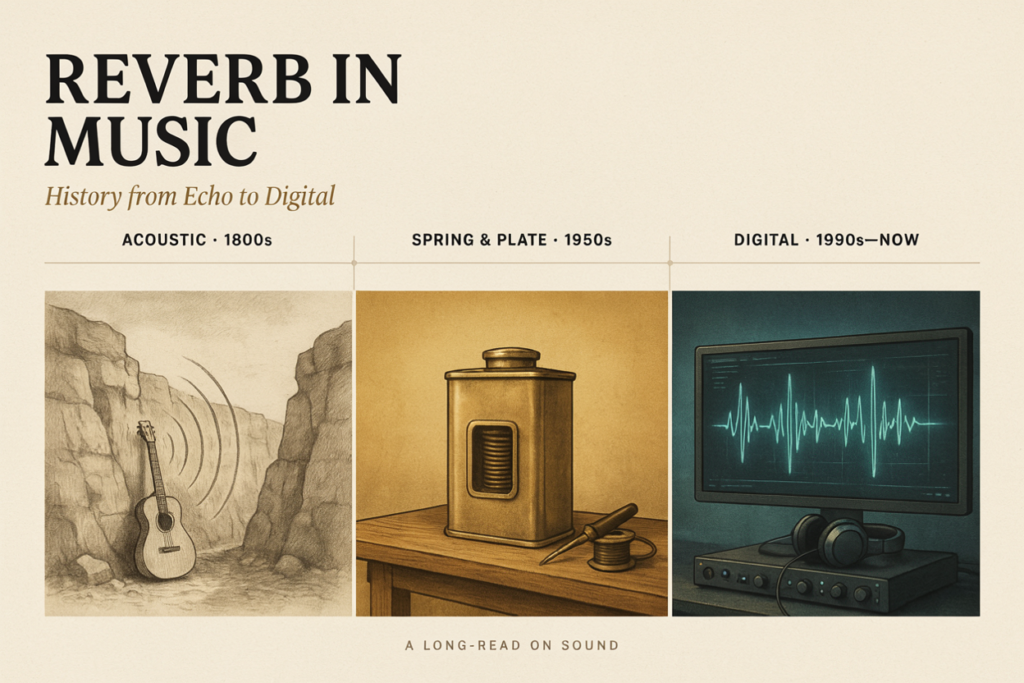
Reverb in music is the collection of closely spaced sound reflections that continues after the original sound and gradually fades away. Musicians and producers use natural or artificial reverb to create space, depth, distance, cohesion, and atmosphere.
You hear the same phenomenon when you clap in a bedroom, stairwell, or church. Each space adds a different reflection pattern. In a recording, reverb can be captured or added during production. For a technical introduction, see how reverberation behaves.
What Is Reverb in Music?
Reverb is the lingering sound produced when reflections arrive so rapidly and densely that they blend into a smooth decay. It tells the listener something about the apparent environment around a voice or instrument, even when that environment was created digitally.
Direct sound reaches the listener first. Early reflections arrive after bouncing from nearby surfaces. A dense tail follows as later reflections lose energy.
Reverb reflections merge into a continuous tail, while echo or delay repetitions remain distinct. A reverb and delay comparison explains how that distinction affects production choices.
How Does Reverb Work?
Reverb works through reflection, absorption, and decay. Sound spreads through a space, strikes surfaces, and returns from many directions while losing energy.
Direct sound and early reflections
Direct sound provides the clearest source information. Early reflections help the brain estimate room size, distance, and surface character. Fast reflections can suggest a small room; later reflections can imply greater distance.
The reverb tail
Multiplying reflections become too dense to hear separately and form the tail. Hard glass or concrete usually preserves more energy than carpets, curtains, and upholstered furniture. Room geometry also shapes the decay.
RT60 is the time required for sound energy to fall by 60 dB after the source stops. The measurement and a plugin’s decay control are related but not always interchangeable. This overview of reverberation time explains the measurement.
Natural and artificial reverb
Natural reverb is recorded around a performance. Artificial reverb uses a chamber, plate, spring, digital algorithm, or convolution process. It can imitate familiar rooms or impossible spaces.
The major families of reverb differ in tone, density, realism, and purpose. Their labels describe a starting character, not a guaranteed result.
What Does Reverb Do to Music?
Reverb changes the perceived space, depth, connection, and emotion of a recording. A dry sound usually feels close and immediate; a more reverberant sound often feels farther away or surrounded by a larger environment.
It creates space and depth
Producers adjust dry signal, early reflections, pre-delay, tail level, and frequency balance to place sounds. More reverb doesn’t guarantee believable depth. Long pre-delay can keep a vocal present while a large tail develops behind it.
It helps connect a mix
Sending separately recorded instruments to one room or chamber can create a common acoustic context. Contrasting spaces can place a dry lead vocal forward and reverberant backing vocals farther away.
Shared and contrasting spaces are central to reverb in music production. The goal is a convincing front-to-back perspective, not simply wetter tracks.
It shapes mood and character
Different reverb characters suggest different musical environments:
| Reverb character | Typical impression | Common musical purpose |
|---|---|---|
| Short room | Close, lively, cohesive | Adds dimension without an obvious long tail |
| Plate | Smooth, bright, dense | Sustains vocals or snares while preserving presence |
| Hall | Large, spacious, gradual | Adds scale to strings, vocals, keys, or sparse arrangements |
| Spring | Metallic, splashy, recognizable | Creates a stylized guitar, keyboard, or dub texture |
| Ambient tail | Expansive, soft, dreamlike | Turns notes into evolving pads or transitions |
These are tendencies, not rules. Decay, damping, filtering, and balance can make two reverbs of the same type sound very different.
How Is Reverb Different From Echo and Delay?
Reverb creates a dense decay that is heard as one acoustic response, while echo and delay create repetitions that remain individually recognizable. The practical difference is whether the effect surrounds the source with a space or produces a rhythmic repeat.
| Feature | Reverb | Echo or delay |
| Audible pattern | Dense, overlapping reflections | Separate repeats |
| Spatial effect | Suggests a room or surrounding field | Suggests a returning or duplicated sound |
| Timing | Often perceived as a continuous tail | Frequently set as a clear time interval |
| Musical role | Depth, cohesion, sustain, atmosphere | Rhythm, call-and-response, movement |
A delay can become reverb-like when repeats are extremely fast and dense. Reverb can also produce audible flutter or discrete reflections in a problematic room, so the boundary is perceptual rather than absolute.
What Are the Main Reverb Controls?
The main controls determine the character, start time, length, density, tone, and level of the reverberant sound. Names vary between hardware and plugins, but the listening decisions remain similar.
Type, size, and early reflections
Type selects the basic character, while size changes the apparent dimensions or reflection pattern. Early-reflection controls influence the initial sense of room and source position before the later tail becomes dominant.
Pre-delay and decay
Pre-delay is the gap between the direct sound and the onset of prominent reverberation. A little separation can protect consonants, drum attacks, or pick transients. The dedicated guide to setting pre-delay explains why longer values can make a source feel clearer rather than simply more distant.
Decay controls how long the tail lasts. Short decay can support rhythmic clarity; long decay can add drama or sustain, but it may overlap later notes.
Diffusion, damping, and wet/dry balance
Diffusion changes how densely and smoothly reflections accumulate. Damping makes selected frequencies—often the high end—fade faster, creating a darker and sometimes more natural tail. Wet/dry balance sets the relationship between processed reverb and the original signal.
On an aux or return channel, reverb is normally set fully wet and balanced with the send level. As an insert, the mix control must preserve the required dry signal. Practical reverb mixing methods cover both routing approaches.
How Can You Hear Reverb in a Song?
Listen just after a vocal phrase, snare hit, or piano chord ends. The dry source stops first, exposing the reflections and tail that were harder to notice while the note was playing.
Try this simple listening exercise:
- Clap once in a furnished bedroom and listen until the sound disappears.
- Repeat the clap in a bathroom, hallway, or stairwell.
- Notice the first reflections, the tail length, and whether the decay sounds bright, dark, smooth, or fluttery.
- Play a recording quietly and focus on the gaps between phrases rather than the notes themselves.
- Compare an intimate verse with a larger chorus and listen for changes in tail length, level, or width.
Headphones can reveal stereo movement, but speakers make it easier to notice how playback-room acoustics combine with recorded reverb. Neither method replaces the other.
When Does Reverb Hurt a Mix?
Reverb hurts a mix when its tail masks lyrics, transients, bass definition, or rhythmic detail. Common fixes include shortening the decay, reducing the send, increasing pre-delay, darkening the tail, or removing unnecessary low-frequency energy.
Dense arrangements usually tolerate less lingering energy than sparse ones. Low frequencies are particularly easy to accumulate because long waves can sustain through the tail and compete with bass instruments. Understanding the frequency response of reverb helps explain why filtering the return can restore clarity without removing the sense of space.
Judge reverb in the full arrangement, not only while the source is soloed. A beautiful long tail may disappear in context—or cover several other parts once everything plays together.
Frequently Asked Questions
Is reverb the same as echo?
No. Reverb contains reflections dense enough to sound like a continuous decay, while echo produces repetitions heard as separate events. Both come from delayed reflections, but listeners perceive them differently.
What is the difference between natural and artificial reverb?
Natural reverb is the response of a real space captured during recording. Artificial reverb is generated by a chamber, plate, spring, algorithm, or convolution system and may simulate a real environment or create an imaginative one.
Why do vocals usually have reverb?
Reverb can help a vocal sit within the musical space, add sustain, and establish emotional scale. Producers often preserve intelligibility with controlled decay, filtering, and enough pre-delay to separate the words from the tail.
Can a song sound good without reverb?
Yes. A deliberately dry production can sound intimate, tight, or confrontational. The recording room and microphones may still capture small reflections even when no reverb effect is added.
Is reverb recorded with the instrument or added afterward?
Either approach is possible. Engineers may capture room sound with microphones during the performance, add artificial reverb during mixing, or combine both methods for greater control.

Noah Bennett is an audio engineering writer and acoustics specialist at Reverb Calculator. He focuses on reverb time calculation, room acoustics, studio sound design, and music production tools for producers, audio engineers, musicians, and home studio creators.