
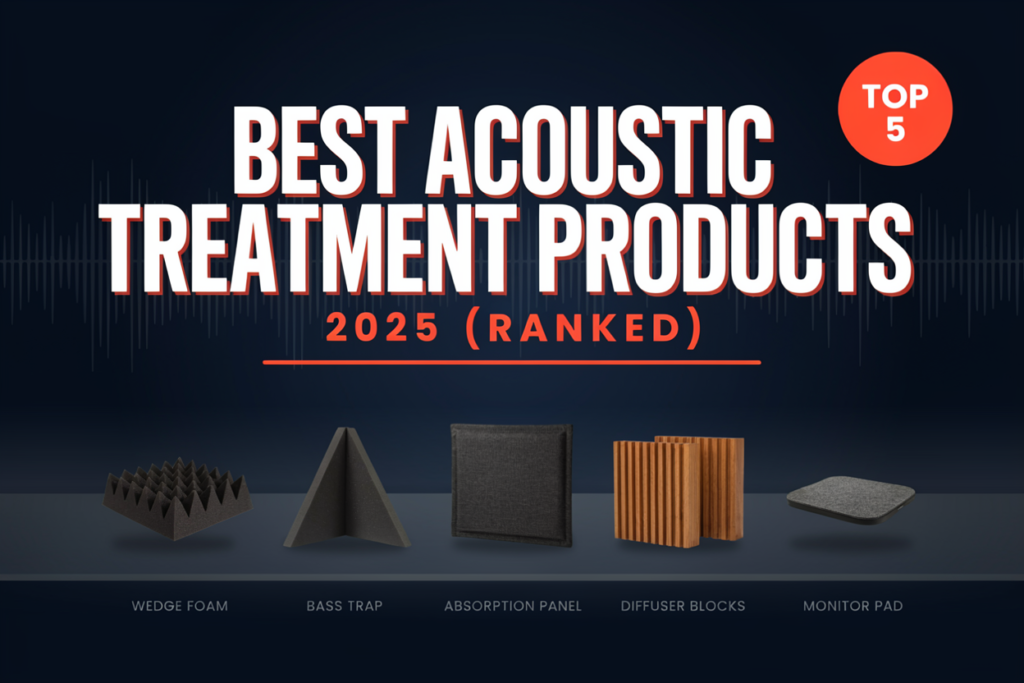
The best acoustic treatment products are the ones that solve a measured room problem. For most small studios, the strongest starting combination is thick broadband panels at first-reflection points, substantial bass traps in corners, and a ceiling cloud above the listening position. Diffusers and portable treatment can help later, but they do not replace low-frequency control or well-placed absorption.
This brand-neutral guide compares products by performance rather than appearance. Start with the broader acoustic treatment principles before deciding how many products to buy.
What Are the Best Acoustic Treatment Products?
There is no single best product for every room. Broadband panels are the most versatile option, bass traps address low-frequency buildup, ceiling clouds control vertical reflections, diffusers scatter sound, and portable gobos reduce reflections around a recording source.
| Product type | Main purpose | Best location | Main limitation |
|---|---|---|---|
| Broadband panel | Controls early reflections and shortens mid/high-frequency decay | Side walls, front wall, rear wall | Thin panels provide limited bass control |
| Bass trap | Reduces low-frequency buildup and uneven decay | Corners and wall–ceiling boundaries | Requires depth and substantial coverage |
| Ceiling cloud | Controls floor-to-ceiling reflections | Above the mix position or recording area | Needs secure overhead mounting |
| Diffuser | Scatters reflections while retaining liveliness | Rear wall or other suitable distant surface | Needs enough room and listening distance |
| Portable gobo | Controls reflections near microphones or instruments | Around a temporary recording zone | Does not correct the whole room |
Broadband panels and bass traps
Broadband panels are usually the first purchase because they can improve stereo imaging and control early reflections. Inspect thickness, mounting method, and octave-band data; the differences among acoustic panel designs matter more than decorative shape.
Bass traps are thicker absorbers intended to work lower in the spectrum. Corners are common starting positions because room boundaries influence low-frequency pressure. Do not assume a thin foam “bass trap” controls deep bass without test data.
Ceiling clouds, diffusers, and gobos
A ceiling cloud controls the strong vertical reflection above a listening or recording position. An air gap can extend absorption lower, although performance depends on the tested assembly.
Diffusers scatter energy and can preserve spaciousness, but choosing and positioning acoustic diffusers requires more distance than many compact bedrooms provide. Gobos provide movable recording control.
How Do You Match Treatment to a Room Problem?
Match each purchase to an audible symptom and, where possible, a measurement. Buying a mixed bundle before identifying bass buildup, early reflections, flutter echo, or microphone spill can waste both money and wall area.
| What you hear | Likely issue | Suitable first treatment |
| Some bass notes boom while others disappear | Room modes and long low-frequency decay | Thick corner bass traps; optimized speaker/listener positions |
| Blurred center image or unstable panning | Strong early reflections | Broadband panels at side-wall reflection points and a ceiling cloud |
| Ringing between bare parallel walls | Flutter echo | Broadband absorption, followed by scattering where suitable |
| Boxy or roomy vocal recordings | Nearby wall and ceiling reflections | Panels, cloud, or portable gobos around the recording zone |
| Room sounds dull but bass remains uneven | Too much thin high-frequency absorption | Add effective bass trapping; reassess existing treatment |
Diagnose before buying
Begin with listening, speaker-position tests, and measurements. Frequency-response plots reveal peaks and nulls; decay plots show how long energy persists. RT60—the time for reflected sound to decay by 60 dB—is frequency-dependent, so one average can conceal a bass problem. Home studio acoustic planning explains how positioning and treatment work together.
Treat the cause, not only the symptom
Absorption cannot always repair a deep cancellation caused by poor placement. Move speakers and the listening position before filling every surface. For vocals, treat reflections reaching the microphone.
What Should You Check Before Buying Acoustic Treatment?
Check octave-band performance, thickness, tested mounting conditions, total coverage, installation hardware, fire documentation, and return terms. A single rating or product label is not enough to predict performance in your room.
Performance and construction
NRC, or Noise Reduction Coefficient, summarizes selected midrange bands; it does not fully describe deep-bass behavior. Review the frequency-by-frequency absorption coefficients and confirm whether testing used direct mounting or an air gap.
Greater thickness generally extends absorption lower, but material, airflow resistance, construction, and mounting also matter. Compare complete products tested under similar conditions.
Safety and installation
Request fire-test documentation for the finished product, including its facing. ASTM E84 reports comparative flame-spread and smoke-developed indices; it is not a fire-resistance rating for an entire wall assembly.
Check mounting loads, fasteners, ceiling anchors, fiber containment, and local requirements. Overhead clouds need hardware appropriate for the ceiling structure.
Are Foam, Fiberglass, or Mineral-Wool Panels Better?
Thick fibrous panels usually provide broader absorption than thin sculpted foam, but material name alone does not establish quality. Tested performance, thickness, coverage, construction, and safe installation should decide the purchase.
Thin foam versus thick fibrous absorbers
Thin foam can reduce flutter and high-frequency reflections, but it cannot replace substantial low-frequency bass trapping. It may remove brightness while leaving bass peaks and long decay unchanged.
Fiberglass, mineral wool, polyester, and other fibers can provide broadband absorption at adequate depth. Compare laboratory data rather than treating one material as automatically superior.
Myth versus reality
Egg cartons cannot replace tested absorbers or diffusers. Rugs, curtains, and decorative felt may reduce upper-frequency reflections but do little for deep room modes. Music rooms usually need thicker, strategically placed treatment.
Where Should You Install Treatment First?
For a small studio, address speaker and listening positions first, then corners, side-wall reflection points, the ceiling reflection, and finally front or rear-wall problems. Installation order should follow measurements and listening tests rather than symmetry alone.
A practical buying order
- Optimize the speaker and listening positions before purchasing treatment.
- Add substantial corner trapping where low-frequency measurements and space allow.
- Place matched broadband panels at left and right first-reflection points.
- Install a securely mounted ceiling cloud above the listening area.
- Measure again, then treat remaining front-wall, rear-wall, or recording-zone problems.
- Consider diffusion only after bass decay and early reflections are controlled.
Quantity depends on room volume, surfaces, use, and absorber performance. Use an appropriate reverberation-time target as a guide without ignoring frequency balance.
How Can You Avoid Wasting Money?
Buy treatment in stages, document the room before and after each stage, and prioritize verified depth and coverage over decorative bundles. Acoustic treatment changes reflections inside a room; it does not soundproof the structure or stop transmission through doors, walls, floors, and ceilings.
Start with the smallest set that addresses the largest verified problems, then remeasure. A room acoustics assessment workflow can separate placement problems from decay problems.
For limited budgets, prioritize placement, effective broadband panels, and safe corner trapping. Next add a ceiling cloud and rear-wall control. Buy diffusion only when room dimensions and listening distance support it.
Frequently Asked Questions About Acoustic Treatment Products
Are acoustic panels or bass traps more important?
Most small studios need both. Bass traps target low-frequency decay, while broadband panels control early reflections; measurements determine which comes first.
How thick should acoustic panels be for a home studio?
Thicker absorbers generally work lower than thin ones. Compare octave-band data for the exact thickness and mounting method.
Is acoustic foam effective for music production?
Foam can control higher-frequency reflections, but thin foam is not a complete treatment system and rarely solves deep bass problems.
How many acoustic panels does a room need?
Panel count depends on room size, performance, placement, and target decay. Install in stages and stop when imaging and decay improve without making the room unnaturally dead.
Do acoustic panels provide soundproofing?
No. Acoustic panels reduce reflections within a room, while soundproofing requires construction methods that address mass, airtightness, decoupling, and structural transmission.
Are acoustic diffusers useful in a small room?
Sometimes, but absorption is usually the safer priority in a compact room. Diffusion helps when listener distance is adequate and bass and early reflections are controlled.

Noah Bennett is an audio engineering writer and acoustics specialist at Reverb Calculator. He focuses on reverb time calculation, room acoustics, studio sound design, and music production tools for producers, audio engineers, musicians, and home studio creators.