
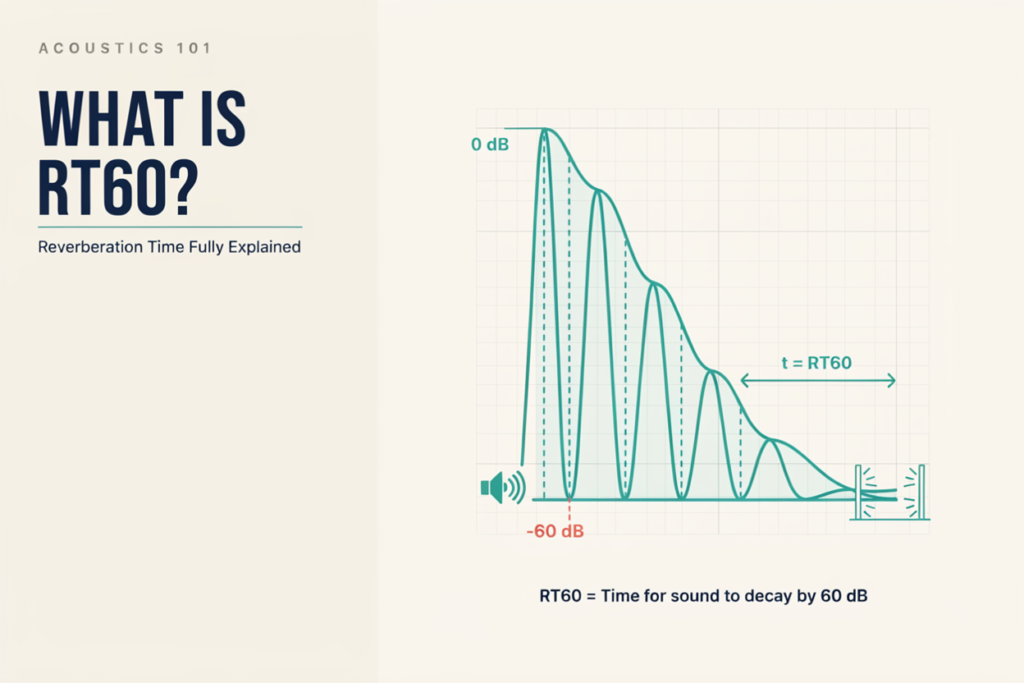
RT60 is the time required for sound energy in a room to decrease by 60 decibels after the original sound source stops. It is one of the main measurements used to describe how long reverberation remains in an enclosed space.
A short RT60 sounds dry and controlled, while a long RT60 sounds more reflective and sustained. RT60 is closely related to how reverberation time is measured, but it must be interpreted in relation to room size, frequency, and intended use.
What Does the “60” in RT60 Mean?
The number 60 refers to a 60 dB reduction in sound level. Measurement begins after the source stops, while reflections continue bouncing between surfaces until their energy is absorbed or escapes.
Is RT60 the Same as Reverberation Time?
RT60 is the most common way of expressing reverberation time. RT60, T60, and reverberation time are often used interchangeably. A reported RT60 may be extrapolated from a shorter T20 or T30 measurement.
What Does RT60 Tell You About a Room?
RT60 indicates how long reflected sound remains after the source stops. It helps predict speech clarity, musical spaciousness, and the amount of room ambience captured in recordings.
What Does a Short RT60 Sound Like?
A short RT60 produces a dry acoustic in which words, notes, and transients remain distinct. Recording booths, control rooms, podcast rooms, and many classrooms benefit from short decay, although an extremely short or uneven response can sound unnatural.
What Does a Long RT60 Sound Like?
A long RT60 creates sustained reflections and a stronger sense of space, which can add fullness and blend to music. For speech, excessive decay causes syllables to overlap and reduces intelligibility.
Why Does RT60 Matter?
RT60 affects clarity, musical blend, comfort, and recording accuracy. The appropriate value depends on the room’s purpose.
Speech and Classroom Acoustics
Speech spaces generally need controlled reverberation. Long decay masks consonants and makes words harder to understand, especially at a distance.
Recording and Mixing Rooms
Recording and mixing rooms usually need short, balanced decay. Long reflections colour microphone signals and make EQ, dynamics, panning, and artificial reverb harder to judge. Low-frequency ringing may remain even when the midrange looks suitable, so understanding overall room behaviour is essential.
Music and Performance Spaces
Music rooms may benefit from longer reverberation because it supports sustain and blend. The ideal balance depends on musical style, ensemble size, and room volume.
How Is RT60 Measured?
RT60 is measured by producing sound in a room, stopping the source, and analysing how quickly the remaining sound energy decays. Professional measurements normally use a room impulse response and examine the decay in separate frequency bands.
Direct RT60 Measurement
A direct measurement needs a clean decay from roughly −5 dB to −65 dB. Ventilation, traffic, people, equipment, or microphone noise often masks the final part.
T20 and T30 Estimates
T20 and T30 estimate RT60 from shorter sections of the decay curve:
- T20 measures approximately −5 dB to −25 dB and multiplies the measured time by 3.
- T30 measures approximately −5 dB to −35 dB and multiplies the measured time by 2.
Common Test Signals
Common test signals include swept sine waves, interrupted noise, balloon bursts, and handclaps. Claps and balloons provide rough estimates; calibrated equipment is more dependable.
What Is the Difference Between RT60, T20, and T30?
RT60 describes a 60 dB decay, while T20 and T30 extrapolate shorter measured ranges to the same target.
| Metric | Typical measured range | Extrapolation | Practical use |
|---|---|---|---|
| RT60 | About −5 to −65 dB | None | Direct full-decay measurement |
| T20 | About −5 to −25 dB | Multiply by 3 | Useful when the noise floor limits the decay |
| T30 | About −5 to −35 dB | Multiply by 2 | Often a more stable practical estimate |
For example, if a 20 dB decay takes 0.40 seconds:
RT60 = 0.40 × 3 = 1.20 seconds
Is RT60 the Same at Every Frequency?
RT60 varies across the frequency spectrum because materials, dimensions, air absorption, and treatment affect frequencies differently.
Why Bass Often Decays More Slowly
Low frequencies are harder to absorb because their wavelengths are long. Small-room modes can also make certain bass notes ring much longer, even when the midrange is controlled.
Why Octave-Band Results Are More Useful
Professional measurements are usually reported in octave or one-third-octave bands. A broadband average can hide imbalances, while band-by-band results reveal where decay needs attention.
How Is RT60 Calculated?
RT60 can be estimated from room volume and total absorption using the Sabine formula:
RT60 = 0.161V ÷ A
Here, V is room volume in cubic metres and A is equivalent absorption area in square metres of sabins. The formula used to estimate RT60 is useful before treatment is installed.
Room Volume and Equivalent Absorption
Room volume is calculated as:
V = length × width × height
Equivalent absorption is found by multiplying each surface area by its absorption coefficient and adding the results:
A = Σ(S × α)
Because absorption varies by material and frequency, use suitable data for how different surfaces absorb sound.
Calculated RT60 Versus Measured RT60
A calculated result is a simplified prediction, while a measurement captures furniture, openings, uneven treatment, modes, and geometry. Use calculations for planning and measurements for checking the finished room. A guide to calculating a room’s sound decay shows how the variables combine.
What Is a Good RT60?
There is no universal ideal RT60. A suitable value depends on volume, use, occupancy, and frequency balance.
RT60 Depends on Room Use
Speech rooms usually need shorter decay than concert halls. Recording rooms require control, while performance spaces may use longer reverberation for musical blend.
RT60 Depends on Room Size and Frequency
Larger rooms can support longer decay than small rooms, and bass targets may differ from midrange targets. Use room-specific guidance when selecting an appropriate decay target.
What Affects RT60?
Room volume, materials, furniture, occupants, curtains, openings, and treatment influence RT60. Larger volume generally increases decay when absorption stays unchanged, while effective absorption reduces decay in the frequencies it covers. An empty hall may therefore sound more reverberant than the same hall with an audience.
What RT60 Does Not Tell You
RT60 is not a complete acoustic quality score. It does not fully describe early reflections, flutter echo, room modes, frequency-response peaks, isolation, or stereo imaging. Two rooms with the same average RT60 can still sound very different.
RT60 also differs from a digital reverb’s decay control. A plugin simulates a reverb tail, while room RT60 describes real acoustic decay. Understanding how reflected sound creates reverb helps separate them.
When decay is excessive, a plan for controlling excessive reflections should address frequency, placement, and coverage.
Frequently Asked Questions
Is RT60 the same as echo?
No. RT60 measures the overall decay of many closely spaced reflections. An echo is a distinct delayed repetition that can be heard separately from the original sound.
Is a lower RT60 always better?
No. A lower value may improve speech clarity and recording control, but excessively short decay can make a room sound unnatural or lifeless. The correct target depends on room use and size.
Can a phone measure RT60 accurately?
A phone can provide a rough estimate with suitable software, but its microphone, automatic gain control, speaker response, and surrounding noise may reduce accuracy. Calibrated equipment is preferable for critical work.
Why are T20 and T30 used instead of measuring 60 dB directly?
The final part of a full 60 dB decay is often buried beneath the background-noise floor. T20 and T30 use cleaner portions of the decay and extrapolate the slope to estimate RT60.
Does acoustic foam reduce RT60 at every frequency?
No. Thin foam mainly absorbs midrange and high-frequency sound. It usually has limited effect on deep bass decay, which often requires thicker porous treatment or dedicated bass trapping.
Is room RT60 the same as decay time in a reverb plugin?
They are related but not identical. Room RT60 measures real acoustic decay, while a plugin’s decay control sets a simulated reverb tail that may not follow the same frequency behaviour or measurement method.

Noah Bennett is an audio engineering writer and acoustics specialist at Reverb Calculator. He focuses on reverb time calculation, room acoustics, studio sound design, and music production tools for producers, audio engineers, musicians, and home studio creators.