
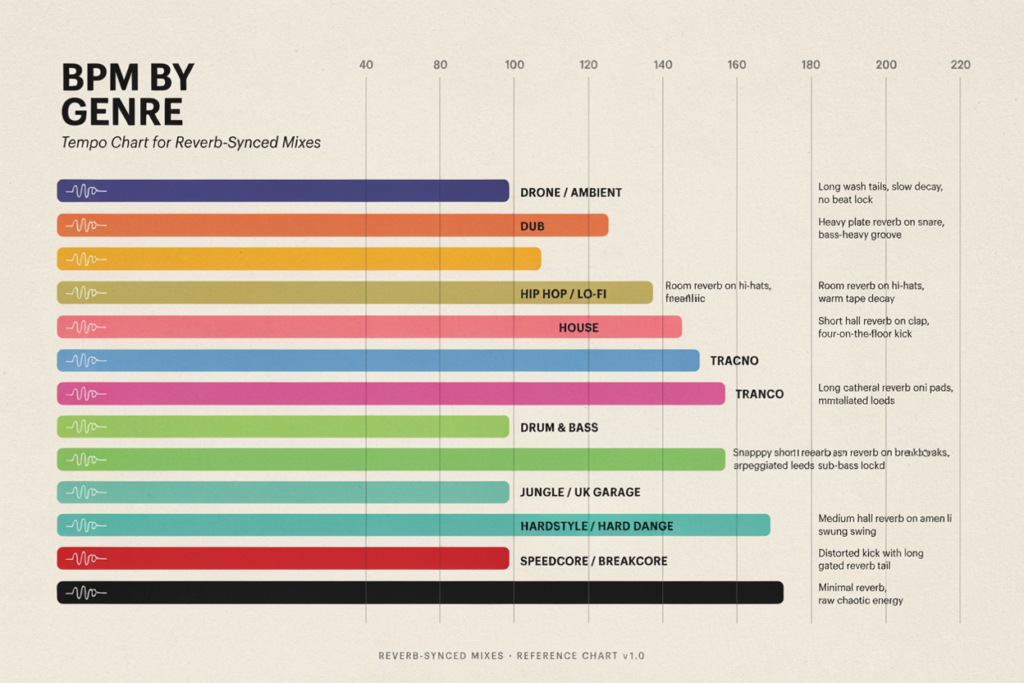
Tempo ranges can help you start a track in the right neighborhood, but they do not define a genre by themselves. A useful BPM by genre chart shows common ranges, while rhythm, accents, instrumentation, swing, and sound design determine whether a track actually sounds like hip-hop, house, rock, or another style.
BPM means beats per minute. At 60 BPM, one beat lasts one second; at 120 BPM, two occur each second. Learn how BPM controls reverb timing before choosing decay or pre-delay.
What Is the Typical BPM by Genre?
Typical genre tempos range from 40–90 BPM for ambient music to 160–180 BPM for drum and bass. House commonly sits around 115–130 BPM, while hip-hop often uses 60–100 BPM or a double-time count. Treat these ranges as starting points, not rules.
| Genre | Approximate BPM range | Common rhythmic feel |
|---|---|---|
| Ambient | 40–90 | Slow, spacious, or pulse-free |
| Ballad | 60–80 | Broad, steady, and vocal-led |
| R&B | 60–100 | Relaxed groove; half-time is common |
| Hip-hop | 60–100 | Laid-back to energetic; may display as 120–200 |
| Lo-fi hip-hop | 60–90 | Relaxed, often swung |
| Reggae | 70–100 | Offbeat emphasis and spacious groove |
| Trap | 65–85 or 130–170 | Usually felt in half time |
| Pop | 90–130 | Broad range with a clear, accessible pulse |
| Funk | 90–130 | Syncopated and groove-centered |
| Disco | 110–130 | Steady four-on-the-floor beat |
| House | 115–130 | Four-on-the-floor dance groove |
| Techno | 120–145 | Repetitive, driving pulse |
| Trance | 125–145 | Fast four-on-the-floor with long phrases |
| Dubstep | 135–145 | Often felt around 70 BPM in half time |
| Drum and bass | 160–180 | Fast subdivisions and broken beats |
| Rock | 80–160 | Wide range, usually driven by backbeat |
| Metal | 90–200+ | Varies from slow doom to extreme-speed styles |
| Jazz | 60–300 | Very broad; ballads and fast bebop differ sharply |
| Classical | 40–200+ | Determined by the piece and tempo marking |
These ranges overlap because tempo is only one part of musical identity. A track at 124 BPM could be pop, disco, funk, house, or techno. The kick pattern, bass movement, and arrangement provide stronger clues. Production choices also vary; compare common hip-hop reverb approaches with spaces used in electronic dance music.
Why Do BPM Charts Show Different Genre Ranges?
BPM charts disagree because genres have flexible boundaries and the same groove can be counted at different rates. One source may label a trap beat as 70 BPM, while another labels the identical timing grid as 140 BPM. Neither reading is automatically wrong.
Genre is defined by more than tempo
A 120 BPM track does not become house simply because it falls inside a common range. Kick placement, hi-hats, bass phrasing, repetition, and sound selection contribute to the style. A rock song at the same tempo may use live drums, guitars, and different accents.
Broad genres such as pop, jazz, rock, and classical music need wide ranges. A slow rock ballad and a fast punk track may share instrumentation but have dramatically different tempos. For guitar-based music, rock reverb settings and arrangement choices should respond to the performance rather than one genre preset.
Published charts use different samples
Some charts describe club conventions, while others analyze releases across decades. Subgenres and changing production trends widen the results. Ableton Learning Music, for example, gives 115–130 BPM for house and 160–180 BPM for drum and bass, but releases may sit outside those bands.
Use a published range as a starting hypothesis. If the groove works better five or ten BPM beyond the listed range, the musical result matters more than the category.
How Do Half-Time and Double-Time Change BPM?
Half-time and double-time change how musicians count the pulse without changing the audio. A groove entered at 70 BPM can be represented at 140 BPM by doubling the grid values.
A 70 BPM versus 140 BPM example
At 70 BPM, one quarter-note beat lasts about 857 milliseconds:
60,000 ÷ 70 = 857 ms
At 140 BPM, one quarter note lasts about 429 milliseconds:
60,000 ÷ 140 = 429 ms
If a 140 BPM arrangement places its main backbeat every two beats, the listener may perceive a 70 BPM pulse beneath faster hi-hats. This is common in trap and dubstep.
The distinction matters when synchronizing effects. A quarter-note delay at 140 BPM equals the duration of an eighth-note delay at 70 BPM. A note-value delay reference can prevent a half-time interpretation from producing echoes twice as long as intended.
When alternate counting is useful
Choose the count that makes editing easiest. A higher project BPM gives clearer grid divisions for fast hi-hats, while a lower value makes the main pulse easier to read. Confirm the convention before exchanging MIDI or tempo-synced settings.
How Do You Choose the Right BPM for a Track?
Choose a BPM inside the genre’s common range, then adjust it while listening to the groove, vocal phrasing, energy, and arrangement. The best tempo makes the musical parts feel natural together.
- Start near the center of the relevant range. For house, you might begin around 122–125 BPM; for a relaxed hip-hop beat, you might begin around 75–85 BPM.
- Build the defining rhythm. Judge the tempo with the intended kick, snare, bass, and subdivision pattern rather than a bare metronome.
- Test a slower and faster version. Move five BPM in each direction, then make smaller one- or two-BPM adjustments.
- Check the lead part. Make sure vocals have enough room for consonants and breaths, and confirm that melodic phrases do not feel rushed or sluggish.
- Review arrangement density. Fast tempos can make busy percussion or short notes feel crowded, while slow tempos can expose empty spaces.
- Confirm the tempo-synced effects. Recalculate delays, pre-delay, and decay references after changing the project BPM.
Once the groove is stable, DAW reverb settings can follow the arrangement rather than a tempo label. Electronic producers can compare EDM-focused reverb strategies when balancing long tails against a dance pulse.
How Does BPM Affect Reverb and Delay Timing?
BPM determines the duration of musical note divisions in milliseconds. Increasing the tempo shortens quarter notes, eighth notes, and sixteenth notes, so synchronized delays repeat sooner and tempo-related reverb references become shorter.
At 120 BPM, a quarter note is 500 ms, an eighth note is 250 ms, and a sixteenth note is 125 ms. These values can guide pre-delay or delay time, but reverb decay does not have to equal one exact note division. The tail should also leave space for the next lyric, drum hit, or chord change.
For a cleaner mix, start with a musical timing value and adjust by ear. A slightly shorter tail may keep a dense arrangement articulate, while a longer tail may support a sparse ambient passage. The wider process is explained in this guide to using reverb in music production.
Frequently Asked Questions About Genre BPM
What is the most common BPM for pop music?
Pop commonly falls between about 90 and 130 BPM, but there is no single standard tempo. Ballads may be slower, while dance-pop can overlap with house and disco around 115–130 BPM.
Can two different genres have the same BPM?
Yes. Genres frequently share tempo ranges; a 125 BPM track could be house, techno, disco, funk, or pop. Rhythm, instrumentation, accents, harmony, and production style distinguish them more reliably than BPM alone.
Is trap usually 70 BPM or 140 BPM?
Trap can be labeled either way because 70 BPM and 140 BPM can represent the same timing relationship in half time and double time. Use the value that makes the drum grid and subdivisions easiest to program, then communicate that convention when collaborating.
What BPM is best for a dance track?
Many house and disco tracks sit around 115–130 BPM, while techno and trance often extend higher. The best choice depends on the groove, desired energy, and subgenre rather than a universal dance tempo.
Does changing BPM change the key of a song?
Changing the project BPM does not inherently change musical key. However, traditional tape-style or varispeed processing can change tempo and pitch together, while most modern time-stretching can alter tempo without transposing the audio.
How can you find the BPM of a song?
Tap along with the beat using a tempo counter, inspect the track in a DAW, or count beats for a timed interval and convert the result to beats per minute. If the result seems unusually slow or fast, test whether the song is being interpreted in half time or double time, then use the tempo to guide clearer reverb choices in the full mix.

Noah Bennett is an audio engineering writer and acoustics specialist at Reverb Calculator. He focuses on reverb time calculation, room acoustics, studio sound design, and music production tools for producers, audio engineers, musicians, and home studio creators.