
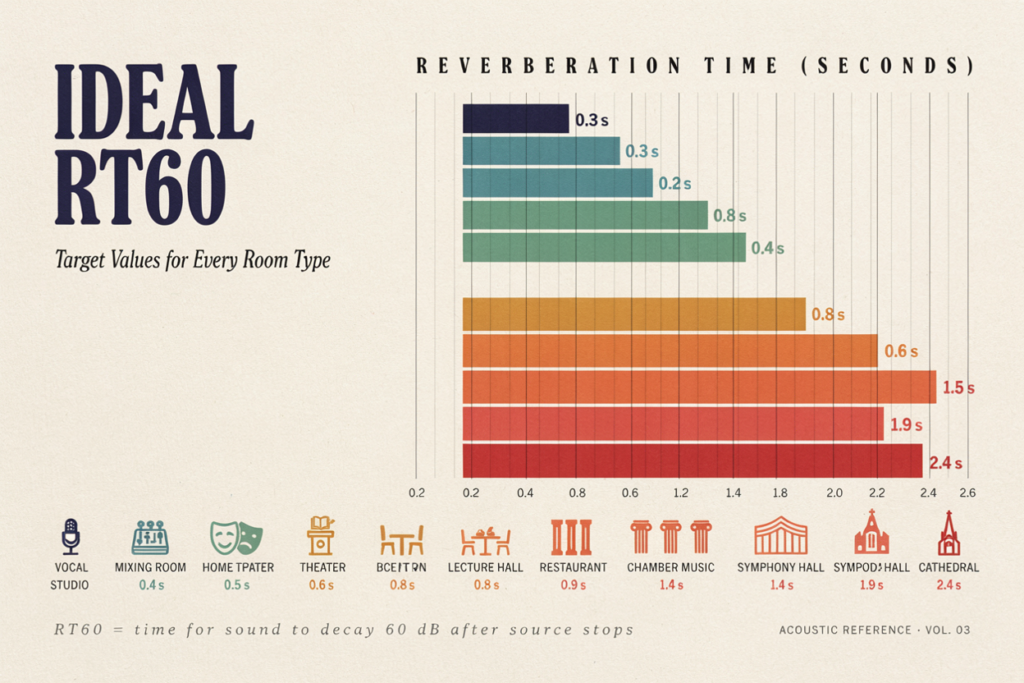
The ideal RT60 is not one universal number. A suitable target depends on the room’s volume, purpose, frequency response, furnishings, and whether it is measured occupied or unoccupied. As practical starting points, critical listening rooms often aim for about 0.2–0.4 seconds, small recording rooms 0.3–0.6 seconds, and speech rooms 0.4–0.7 seconds.
RT60 is the estimated time sound takes to decay by 60 decibels after the source stops. It describes a physical room, not a reverb plugin control. See what RT60 means in room acoustics for the underlying metric.
What Is a Good RT60 for Different Rooms?
A good RT60 supports the room’s main job. Shorter decay generally improves clarity, while longer decay can add musical blend. These are design starting points, not compliance limits.
| Room use | Practical starting range | Main objective |
|---|---|---|
| Vocal booth or dry recording space | 0.2–0.4 s | Limit audible room coloration |
| Critical listening or control room | 0.2–0.4 s | Preserve monitoring clarity |
| Small live recording room | 0.3–0.6 s | Balance definition and ambience |
| Classroom or speech room | 0.4–0.7 s | Support speech intelligibility |
| Office or meeting room | 0.5–0.8 s | Reduce speech buildup and fatigue |
| Lecture hall | 0.8–1.5 s | Balance projection and intelligibility |
| Concert hall | 1.4–2.2 s | Support musical blend and reverberance |
Large venues and multipurpose spaces need room-specific design because speech and music can require conflicting decay characteristics. Published criteria may also specify frequency bands and test conditions rather than one broadband value. The broader concept of reverberation time and its audible effects explains why one use may need a different target from another.
Why room volume changes the target
Larger rooms can support longer decay. EBU Tech 3276 gives reference listening rooms a nominal mid-frequency target of:
[
T_m = 0.25(V/100)^{1/3}
]
Here, (V) is room volume in cubic metres. For 50 m³, the result is 0.20 seconds; for 100 m³, it is 0.25 seconds. These are reference targets, not general recording-room rules.
Why occupancy and furnishings matter
People and soft furnishings absorb sound, so an occupied room will usually decay faster than the same room when empty. Record whether the space was occupied, unoccupied, or furnished but unoccupied, plus the positions of movable curtains and doors.
Why Must RT60 Be Checked by Frequency?
RT60 is frequency-dependent, so a single overall average can hide serious problems. A room may have controlled midrange decay but prolonged bass ringing, or it may have heavily absorbed treble while the low end remains uneven.
Low-frequency decay in small rooms
Room modes create position-dependent peaks, nulls, and long decay at frequencies related to room dimensions. They may not form the smooth, diffuse decay assumed by simple formulas, so examine a waterfall plot or spectrogram alongside frequency response.
Thin foam may shorten high-frequency decay without materially controlling deep bass. Lingering low frequencies may require better speaker and listener placement plus deeper absorbers rather than more thin surface treatment.
Midrange and high-frequency balance
Speech criteria commonly focus on 500 Hz, 1 kHz, and 2 kHz because these bands affect intelligibility. Listening guidance may evaluate a wider series of bands.
The goal is not identical decay at every frequency. Seek a smooth transition: a sudden high-frequency drop can indicate excessive absorption, while an isolated long-decay band may reveal a resonance.
What Is the Difference Between RT60, T20, T30, and EDT?
RT60 is the full 60 dB decay concept, while T20 and T30 estimate that value from shorter measured sections. EDT describes the initial decay and can better reflect how quickly reverberance is perceived immediately after a sound.
| Metric | Decay segment commonly used | What it describes |
| RT60 | Full 60 dB decay | The underlying reverberation-time concept |
| T20 | Approximately −5 to −25 dB | A 20 dB slope extrapolated to 60 dB |
| T30 | Approximately −5 to −35 dB | A 30 dB slope extrapolated to 60 dB |
| EDT | Initial 0 to −10 dB | Early decay extrapolated to 60 dB |
A complete 60 dB decay is often unavailable above the background-noise floor. T20 and T30 are therefore normal methods. T30 needs more usable dynamic range, while T20 may remain available in noisier conditions.
EDT and T30 can differ when decay is uneven. Strong early absorption followed by a lingering resonance may produce a short EDT but longer T30. Interpret the RT60 formula and related decay metrics with the decay curve.
How Do You Measure and Calculate RT60?
Measure RT60 from an impulse response captured with a suitable test signal and measurement microphone. Use multiple positions, consistent room conditions, and frequency-band results.
A repeatable measurement workflow
- Define the room’s normal operating and occupancy condition.
- Set the source and calibrated or characterized measurement microphone.
- Capture an impulse response using a sweep or another suitable test signal.
- Repeat the test at multiple representative positions.
- Confirm that the decay remains sufficiently above the background noise.
- Calculate EDT, T20, or T30 in octave or one-third-octave bands.
- Compare equivalent positions and conditions rather than mixing unlike tests.
- Save the decay curves and document furniture, doors, curtains, and occupants.
A phone and handclap can reveal flutter echo or a large change, but automatic gain control, limited bass response, noise, and inconsistent impulses reduce accuracy. It is not an ISO-compliant test. A detailed reverberation-time measurement workflow separates estimation from formal testing.
Sabine and Eyring predictions
In metric units, the Sabine relationship is:
[
T = \frac{0.161V}{A}
]
Here, (T) is reverberation time in seconds, (V) is room volume in cubic metres, and (A) is equivalent absorption area in square metres of sabins. A 100 m³ room targeting 0.4 seconds would require an estimated total absorption area of:
[
A = \frac{0.161 \times 100}{0.4} = 40.25
]
This planning estimate does not show placement, frequency variation, or whether the room behaves as a diffuse field. Use the Sabine calculation and its assumptions with those limits stated.
Eyring accounts differently for higher average absorption and may suit some treated rooms. Neither model fully predicts modes, early reflections, or seat variation. Check the Eyring approach to reverberation prediction against measurements.
How Do You Adjust RT60 Without Over-Treating the Room?
If decay is too long, treat the affected frequencies at effective locations. If it is too short, stop adding absorption and consider restoring useful reflection or scattering where room size supports it.
When decay is too long
Distribute broadband absorption rather than covering one surface at random. Treat strong early reflections and flutter echo deliberately, then use thicker absorbers where low-frequency decay remains excessive. A practical room-acoustics diagnosis and treatment sequence begins with speaker and listener placement before permanent treatment.
When only part of the spectrum is wrong
Match the treatment to the problem. Do not add thin treble absorption merely to lower the broadband average, and do not expect it to shorten deep modal ringing. Compare measurements after each meaningful change so the effect of placement, depth, and coverage remains clear.
RT60 cannot describe frequency response, early reflections, imaging, noise, or seat consistency. Chasing 0.3 seconds while ignoring bass resonance is a common mistake. A balanced acoustic-treatment strategy uses decay as one diagnostic among several.
Frequently Asked Questions
What is the ideal RT60 for a home studio?
About 0.2–0.4 seconds is a common starting range for a small critical-listening room, while a recording room may suit roughly 0.3–0.6 seconds. Room volume, frequency-dependent decay, and the desired amount of natural ambience should determine the final target.
What is the ideal RT60 for a vocal booth?
A dry vocal booth often targets approximately 0.2–0.4 seconds. The result should still be checked by frequency because a booth can sound dull in the treble while retaining boxy low-mid resonances.
Is 0.3 seconds best for every recording studio?
No. A 0.3-second target may suit some small control rooms, but room volume, use, monitoring distance, and frequency balance can justify a different value. A live recording room may intentionally use a longer decay.
Should RT60 be the same at every frequency?
Not necessarily. The decay should be reasonably smooth and appropriate for the room’s purpose, but perfectly identical values across all bands are rarely realistic. Large jumps between adjacent bands deserve investigation.
Can a phone measure RT60 accurately?
A phone can provide a rough comparison when the setup and room conditions remain consistent. Its microphone response, automatic processing, background noise, and the test signal can prevent reliable low-frequency or standards-grade results.
What is the difference between calculated and measured RT60?
Calculated RT60 predicts decay from room volume and estimated absorption under simplifying assumptions. Measured RT60 is derived from the room’s actual impulse response and includes the effects of its installed surfaces, geometry, furnishings, and test condition.

Noah Bennett is an audio engineering writer and acoustics specialist at Reverb Calculator. He focuses on reverb time calculation, room acoustics, studio sound design, and music production tools for producers, audio engineers, musicians, and home studio creators.