
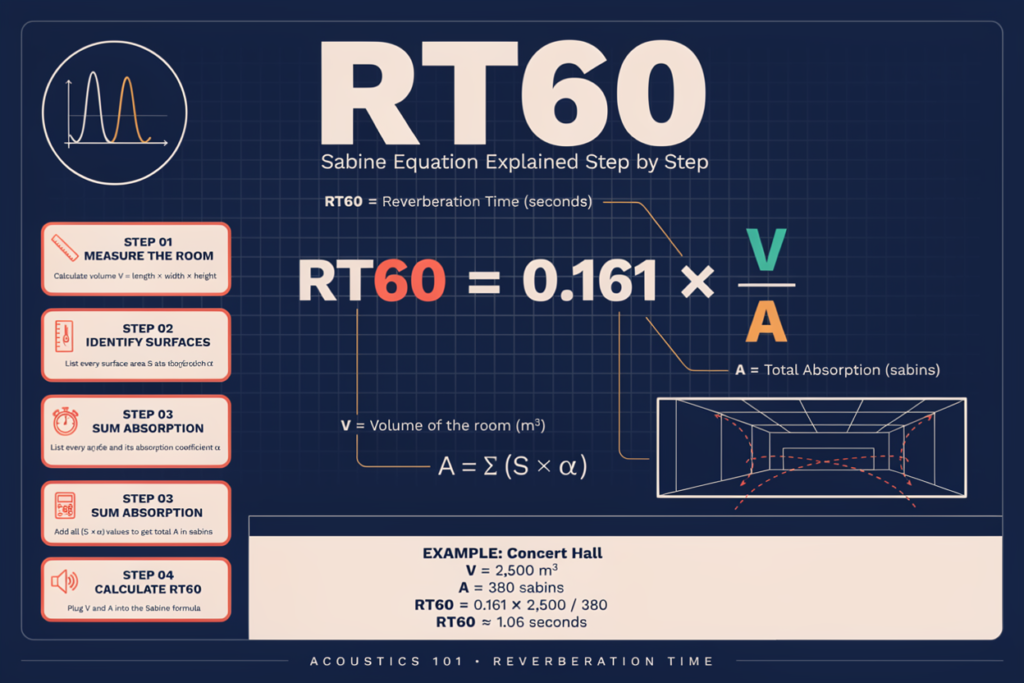
Sound does not disappear the instant a source stops. It reflects from walls, floors, ceilings, furniture, and other surfaces, gradually losing energy with each bounce. The RT60 formula estimates how long that decay takes. Specifically, RT60 is the time required for the sound level in a room to fall by 60 decibels after the source becomes silent.
This measurement is used in recording studios, classrooms, theaters, concert halls, vocal booths, churches, and home listening rooms. A long RT60 makes a room sound more reverberant, while a short RT60 makes it sound drier and more controlled.
For a broader explanation, see how reverberation time affects room sound.
What Is the RT60 Formula?
The most common RT60 equation is the Sabine Formula:
RT60 = 0.161 × V ÷ A
Where:
| Variable | Meaning | Unit |
|---|---|---|
| RT60 | Time for sound to decay by 60 dB | Seconds |
| V | Room volume | Cubic meters |
| A | Total equivalent absorption area | Metric sabins |
The constant 0.161 is used when volume is measured in cubic meters. With imperial units, the formula is commonly written as:
RT60 = 0.049 × V ÷ A
In that version, volume is measured in cubic feet and absorption is expressed in imperial sabins.
The relationship is straightforward: increasing room volume usually increases reverberation time, while increasing absorption reduces it.
What Does Total Absorption Mean?
Total absorption is the combined sound-absorbing effect of the room’s surfaces. It is calculated by multiplying each surface area by its absorption coefficient and adding the results:
A = S1α1 + S2α2 + S3α3 + …
Here, S is surface area, α is the absorption coefficient, and A is total equivalent absorption area.
An absorption coefficient usually ranges from about 0 to 1. A value near 0 means the material reflects most incident sound, while a value near 1 means it absorbs most of it at the measured frequency.
For example, a 20-square-meter surface with an absorption coefficient of 0.50 contributes:
20 × 0.50 = 10 sabins
Absorption changes with frequency, so RT60 should ideally be calculated separately for octave bands such as 125 Hz, 250 Hz, 500 Hz, 1 kHz, 2 kHz, and 4 kHz.
The guide to sound absorption coefficients explains how these material values are used.
How Do You Calculate RT60?
To calculate RT60, determine the room volume, calculate the absorption contributed by each surface, add those values, and insert the result into the Sabine Formula.
Step 1: Calculate Room Volume
For a rectangular room:
Volume = Length × Width × Height
Suppose a room measures 6 meters long, 4 meters wide, and 3 meters high:
6 × 4 × 3 = 72 m³
Step 2: Calculate Surface Areas
For the same room:
- Floor: 24 m²
- Ceiling: 24 m²
- Two long walls: 36 m²
- Two short walls: 24 m²
Doors, windows, curtains, and acoustic panels should be calculated separately when they use different materials.
Step 3: Calculate Surface Absorption
Assume the room has these materials at a selected frequency:
| Surface | Area | Coefficient | Absorption |
| Carpeted floor | 24 m² | 0.25 | 6.00 sabins |
| Plaster ceiling | 24 m² | 0.05 | 1.20 sabins |
| Painted walls | 54 m² | 0.06 | 3.24 sabins |
| Acoustic panels | 6 m² | 0.80 | 4.80 sabins |
Total absorption:
6.00 + 1.20 + 3.24 + 4.80 = 15.24 sabins
Step 4: Apply the Formula
RT60 = 0.161 × 72 ÷ 15.24
RT60 ≈ 0.76 seconds
The predicted reverberation time is about 0.76 seconds at the frequency represented by the chosen absorption coefficients.
For another worked explanation, see how to calculate reverb time step by step.
When Is the Sabine Formula Accurate?
The Sabine Formula works best when the sound field is reasonably diffuse, absorption is not extremely high, and absorptive materials are distributed around the room.
A diffuse sound field means reflections arrive from many directions rather than being dominated by one or two strong paths. Real rooms are never perfectly diffuse, but larger spaces with varied surfaces may approach that condition.
Sabine calculations become less reliable in rooms with very high absorption, unusual geometry, uneven treatment, strong flutter echoes, connected spaces, or dominant low-frequency resonances. The formula predicts statistical decay; it does not directly describe isolated echoes, standing waves, or bass buildup.
Sabine Formula vs Eyring Formula
The Eyring Formula is often preferred when average absorption is relatively high. It uses a logarithmic relationship rather than the simpler linear assumption of the Sabine equation.
| Feature | Sabine Formula | Eyring Formula |
| Best suited to | Low or moderate absorption | Moderate or high absorption |
| Complexity | Simpler | Slightly more complex |
| Common use | Halls, classrooms, studios | Treated rooms and booths |
| Main limitation | May overestimate RT60 in dead rooms | Still assumes a diffuse field |
The Eyring equation is commonly written as:
RT60 = 0.161V ÷ [-S ln(1 – ᾱ)]
S is total surface area, and ᾱ is the average absorption coefficient.
For a deeper comparison, read about the Eyring reverberation equation and the Sabine calculation method.
Why Does Measured RT60 Differ From Calculated RT60?
Calculated RT60 is a prediction, while measured RT60 reflects the real room. Furniture, people, curtains, equipment, air absorption, and construction details all affect the result.
Room geometry also matters. Alcoves, angled ceilings, balconies, open doors, and connected spaces can create multiple decay slopes. Low-frequency modes may decay much more slowly than midrange frequencies.
Measurement methods can also produce different values. T20 and T30 estimate reverberation from 20 dB or 30 dB of measured decay and extrapolate the result to 60 dB. EDT, or early decay time, focuses on the first part of the decay and may better describe the room’s perceived liveliness.
What Is a Good RT60 Value?
A suitable RT60 depends on room size, purpose, occupancy, and frequency. Speech-focused rooms generally need shorter decay for clarity, while performance spaces may use longer reverberation for musical fullness.
| Room type | Approximate RT60 range |
| Vocal booth | 0.15–0.30 seconds |
| Small control room | 0.20–0.40 seconds |
| Recording studio | 0.25–0.60 seconds |
| Home theater | 0.30–0.50 seconds |
| Classroom | 0.40–0.70 seconds |
| Conference room | 0.50–0.80 seconds |
| Church | 1.50–3.00 seconds |
| Concert hall | 1.80–2.20 seconds |
These are broad planning ranges, not universal requirements. The guide to ideal RT60 values for different spaces provides more context.
Common RT60 Calculation Mistakes
A common mistake is using one absorption coefficient for every frequency. Carpet may absorb upper frequencies well while doing little to control bass, so a single broadband estimate can hide important problems.
Other frequent errors include:
- Mixing metric and imperial units
- Forgetting doors, windows, or panels
- Using absorption data for the wrong mounting method
- Ignoring furniture and occupants
- Treating a calculated value as an exact measurement
- Applying Sabine to a highly absorptive room
- Assuming a good average RT60 guarantees good bass response
The room acoustics guide explains how reverberation, reflections, and low-frequency behavior interact.
FAQ
What is the RT60 formula used for?
The RT60 formula predicts how long sound takes to decay by 60 dB inside an enclosed space. It is used for acoustic planning, treatment design, studio construction, and room evaluation.
What is one sabin?
One metric sabin equals one square meter of perfectly absorbing surface. In practice, sabins represent the combined absorption contributed by real materials with coefficients below 1.
Should RT60 be calculated at different frequencies?
Yes. Because absorption changes with frequency, RT60 is normally evaluated in separate octave or one-third-octave bands. A room may have a short treble decay but a much longer bass decay.
Is Sabine or Eyring more accurate?
Sabine is generally suitable for low to moderately absorptive rooms. Eyring often performs better when average absorption is high, although both depend on simplified diffuse-field assumptions.
Can the RT60 formula replace a room measurement?
No. The formula is useful for prediction, but an in-room measurement captures actual geometry, furnishings, frequency variation, and construction details that a simple equation cannot fully represent.

Noah Bennett is an audio engineering writer and acoustics specialist at Reverb Calculator. He focuses on reverb time calculation, room acoustics, studio sound design, and music production tools for producers, audio engineers, musicians, and home studio creators.