
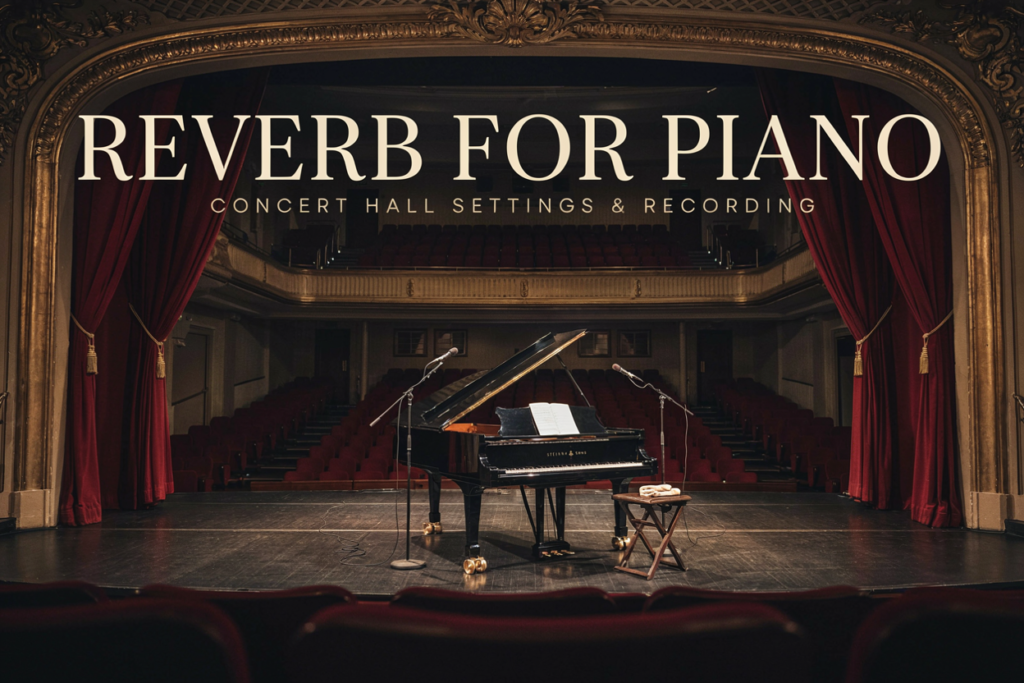
Piano reverb should create depth without hiding hammer attacks, chord changes, or pedal detail. As a starting point, try a 0.7–1.5-second room or chamber for pop and rhythmic piano, or a 1.8–3.0-second hall for exposed solo piano. Then adjust decay, pre-delay, filtering, and effect level in the full arrangement.
There is no universal preset. Tempo, note density, pedal use, microphone perspective, and the piano’s role all affect the result. The broader principles in DAW reverb setup apply, but piano’s wide range and long sustain need particular care.
What Are the Best Reverb Settings for Piano?
The best piano reverb settings preserve each note’s attack while letting the decay connect the performance to a believable or intentionally creative space. Use these ranges as audition points, not fixed rules.
Quick Piano Reverb Starting Settings
| Piano context | Reverb type | Decay | Pre-delay | Main goal |
|---|---|---|---|---|
| Solo classical | Hall or scoring stage | 1.8–3.0 s | 10–35 ms | Create a convincing performance space |
| Piano-and-vocal ballad | Chamber or hall | 1.4–2.4 s | 20–50 ms | Add depth without masking lyrics |
| Pop or rock piano | Room or short chamber | 0.7–1.5 s | 15–40 ms | Keep chords clear in a busy mix |
| Fast rhythmic piano | Short room | 0.4–1.0 s | 5–25 ms | Preserve note separation and groove |
| Ambient or cinematic | Hall or modulated reverb | 2.5–6.0 s | 20–80 ms | Create an intentionally expansive tail |
| Upright or intimate | Small room or chamber | 0.6–1.4 s | 5–30 ms | Add believable proximity and depth |
A source with room ambience may need a shorter tail—or no additional effect. Before choosing, compare room, chamber, hall, plate, and other reverb types.
Which Reverb Type Works Best?
Room reverb adds close, natural cohesion and suits rhythmic parts. Chamber reverb gives a smoother, denser tail without the scale of a concert venue. A hall reverb’s larger sound often suits solo, classical, ballad, and cinematic piano.
Plate reverb is polished rather than literally room-like. Convolution uses a captured impulse response; algorithmic reverb offers flexible timing, modulation, and tone.
How Do You Set Piano Reverb Step by Step?
Set piano reverb by evaluating the dry source first, choosing the intended distance, and shortening the decay until notes and harmonic changes remain distinct. Make final decisions in the complete mix, especially during the busiest or most pedal-heavy passage.
- Bypass all reverb and listen for recorded room tone or built-in ambience.
- Choose a small room, chamber, or hall according to the intended scale.
- Set decay while listening to the fastest or densest phrase.
- Adjust pre-delay until the hammer attack is clear but not detached.
- Raise the effect from silence until the desired depth appears.
- Filter the return and recheck low chords, sustain-pedal passages, and vocals.
How Should You Choose Decay Time?
Short decay suits quick playing and dense arrangements; longer decay suits exposed notes and slow harmonic movement. If a tail carries one chord into the next, shorten or automate it. Pedal resonance and reverb are different, but both can produce cloudiness.
Tempo provides a reference: quarter-note duration in milliseconds is (60{,}000 \div BPM). A tempo-synced reverb workflow is a starting method, not a rule that decay must equal a note value.
How Much Pre-Delay Should You Use?
Pre-delay is the gap between the dry sound and reverb onset. Little pre-delay blends the piano into the room; moderate pre-delay preserves its attack. Excess can resemble an echo, so use the relationship between pre-delay, clarity, and distance and adjust by ear.
On an auxiliary return, use 100% wet and control the amount with the send or return. Start low and raise it in context. More wet signal generally makes the piano seem farther away.
How Do You Keep Piano Reverb From Sounding Muddy?
To reduce muddy piano reverb, lower the send, shorten the decay, and remove unnecessary low-frequency energy from the return. Check sustained low chords first because the piano can excite a broad frequency range at once.
How Should You EQ the Return?
High-pass the effect return only as far as the mix permits; this reduces rumble and bass accumulation without thinning the dry instrument. If chords still sound congested, reduce the troublesome low-mid area. Darkening the upper tail can move it behind vocals and soften brittle hammer noise. These are context decisions, as explained in a broader reverb-mixing workflow.
Subtle sidechain ducking can lower the return during notes and release it between phrases, preserving attacks. It is useful in pop but unnecessary for natural solo piano.
Piano Reverb Troubleshooting
| What you hear | Likely cause | First adjustment |
| Chord changes smear together | Decay is too long | Shorten decay |
| Bass sounds cloudy | Too much low end feeds the tail | Filter the return or reduce low-note sends |
| Reverb sounds like a separate echo | Excessive pre-delay | Reduce pre-delay |
| Tail rings or sounds metallic | Unsuitable algorithm or impulse response | Change the reverb type |
| Piano becomes unrealistically wide | Wide source and wide return are stacking | Narrow the return |
| Two rooms seem to clash | Source ambience conflicts with added reverb | Reduce one space |
How Should Reverb Change for Different Piano Styles?
Piano reverb should follow the arrangement’s density and aesthetic. Natural styles prioritize believable placement; pop mixes prioritize clarity; ambient production may use the tail as part of the composition.
Solo Piano and Piano With Vocals
For solo or classical piano, complement the microphone perspective and preserve dynamic contrast. Do not use a long hall merely to disguise an unsuitable recording.
For piano with vocals, one shared chamber or hall creates coherence while different send levels preserve separation. Shorten or darken the piano tail for vocal clarity, and automate sends when sections need different depth.
Pop, Rock, and Cinematic Piano
Pop and rock usually benefit from shorter, darker ambience. Narrow the piano or its return if guitars and vocals already occupy the sides, and feed less low-register signal into the effect.
Ambient and cinematic parts can support long halls, modulation, or layered spaces. Control bass buildup before lengthening the tail, then automate around harmonic changes. Shimmer and reverse treatments are sound design rather than attempts to reproduce natural piano acoustics.
Should Acoustic and Virtual Pianos Use the Same Reverb?
Acoustic and virtual pianos should not automatically use the same reverb settings. An acoustic recording may contain microphone bleed and real room decay, while a virtual instrument may include sampled room microphones, release sounds, resonance, and built-in ambience.
Acoustic Piano
Listen to the recorded space first. Close and room microphones may already provide depth; additional reverb should extend or unify it, not introduce a conflicting signature. A dry production may need no extra effect.
Virtual Piano
Check the instrument’s room, microphone, release, and resonance controls first. Reduce internal ambience if an external shared return will place the whole arrangement together. A convolution reverb and impulse-response approach can recreate a captured space, while an algorithmic effect is easier to reshape.
Stereo reverb adds envelopment, but stereo piano may already be wide. Mono or narrow ambience can improve localization. Check mono compatibility: a wider tail does not automatically create a realistic hall.
Frequently Asked Questions
Should You Add Reverb While Recording an Acoustic Piano?
Record reverb only when you are confident it is part of the final sound and can also preserve a dry signal. Capturing natural room microphones separately usually leaves more control during mixing.
Is Hall or Room Reverb Better for Piano?
Hall reverb generally suits exposed, slow, or cinematic piano; room reverb suits intimate or rhythmic parts. The right choice depends on arrangement density and intended distance, not the instrument alone.
How Do You Keep Piano Reverb From Pushing It Behind the Vocal?
Lower the piano send, shorten or darken its tail, and use enough pre-delay to retain note attacks. A shared reverb can still work if the vocal and piano receive different send amounts.
Should Low Piano Notes Be Sent to Less Reverb?
Often, yes. Filtering the return or reducing the low register’s send can prevent bass accumulation while allowing midrange and upper notes to retain space.
Can Delay Work Better Than Reverb on Rhythmic Piano?
Yes. A short or tempo-related delay can create movement while preserving more separation than a dense reverb tail; the practical differences between delay and reverberant space help determine which fits the groove.
Should Sustain-Pedal Passages Use Different Settings?
They may need a lower send or shorter decay because pedal resonance already connects notes. Automation can reduce buildup in sustained sections while retaining a larger effect elsewhere.

Noah Bennett is an audio engineering writer and acoustics specialist at Reverb Calculator. He focuses on reverb time calculation, room acoustics, studio sound design, and music production tools for producers, audio engineers, musicians, and home studio creators.