
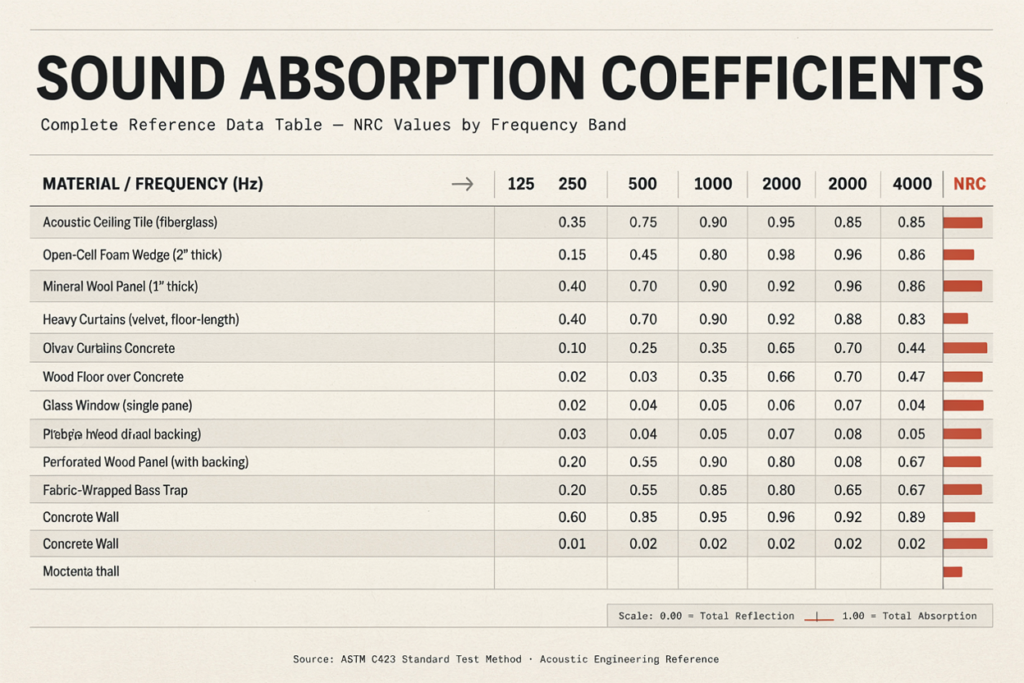
Sound absorption coefficients describe how much sound energy a tested assembly absorbs at a specific frequency. The coefficient is written as α (alpha) and is interpreted on a scale from 0.00, meaning almost no absorption, to 1.00, meaning complete absorption under the stated test conditions.
The crucial detail is “at a specific frequency.” A material may absorb speech-range sound effectively while doing little at bass frequencies, so one summary rating never tells the whole story. When planning acoustic treatment for a room, use the full frequency-band data whenever possible.
What Is a Sound Absorption Coefficient?
A sound absorption coefficient is the ratio of sound energy absorbed by a surface to the sound energy incident upon it. The relationship is:
α = absorbed sound energy ÷ incident sound energy
An α of 0.70 at 1,000 Hz means the tested assembly absorbed approximately 70% of the incident sound energy at that frequency under the laboratory’s mounting and measurement conditions. The remaining energy is reflected or transmitted through the assembly.
Absorption is not the same as sound isolation. Absorptive materials reduce reflections within a room; soundproofing assemblies reduce sound transmission between spaces. A porous panel can make a recording room less reverberant without preventing bass or voices from passing through its walls.
Why Do Absorption Coefficients Change With Frequency?
Absorption coefficients change with frequency because acoustic wavelengths interact differently with a material’s thickness, structure, density, and mounting. Porous absorbers commonly perform well in the mid and high frequencies, while effective low-frequency absorption generally requires greater depth, an air gap, or a purpose-built bass absorber.
Reading frequency-band data
Laboratory reports commonly show coefficients at octave or one-third-octave bands. A table may list 125, 250, 500, 1,000, 2,000, and 4,000 Hz rather than one universal number. These bands reveal how the assembly behaves from bass through the speech and presence ranges.
For example, a hypothetical panel could measure 0.20 at 125 Hz, 0.65 at 500 Hz, and 0.95 at 2,000 Hz. Calling it a “0.95 absorber” would conceal its much weaker bass performance. This frequency-dependent behavior is also why bass traps need different design priorities from thin treatment intended to control flutter echo.
Thickness, air gaps, and mounting
Increasing the thickness of a porous absorber usually extends useful absorption toward lower frequencies. Placing an air gap behind it can also improve low-frequency performance because the absorber sits farther from the rigid boundary, where particle velocity is greater for some wavelengths.
Mounting details matter enough that two visually similar products can have different test results. Compare coefficients only when you know the specimen thickness, mounting method, backing, air space, facing, and test standard. A decorative covering that restricts airflow can also alter the performance of an otherwise porous material.
How Do Common Materials Compare?
Hard, dense surfaces generally reflect more sound than thick, porous materials, but no material has one permanent absorption coefficient. The values below are illustrative behavior patterns rather than substitute specifications; actual coefficients must come from a report for the exact assembly and mounting condition.
| Material or assembly | Typical acoustic behavior | Main limitation |
|---|---|---|
| Painted concrete or tile | Highly reflective across much of the audible range | Adds little useful room absorption |
| Carpet over a hard floor | Stronger absorption at high frequencies than at bass frequencies | Can make a room dull on top while lows remain uncontrolled |
| Heavy curtain with folds and an air space | Useful mid- and high-frequency absorption | Performance depends on fabric weight, fullness, and mounting |
| Porous acoustic panel | Broad mid/high absorption; thicker versions can reach lower | Thin panels are not bass traps |
| Deep porous or resonant bass absorber | Designed for improved low-frequency absorption | Placement and tuning can be critical |
Room treatment should respond to an identified problem. Use acoustic panels and their placement to manage early reflections and general decay, while using sufficient depth for persistent low-frequency ringing. Absorption is also different from diffusion: acoustic diffusers redistribute reflections rather than primarily removing their energy.
What Is the Difference Between α, NRC, SAA, and αw?
Individual α values show absorption by frequency, while NRC, SAA, and αw reduce broader test data to single-number ratings. Single-number ratings make product comparison convenient, but they cannot reveal every low-frequency weakness or narrow-band irregularity.
NRC and SAA
Under ASTM C423, the Noise Reduction Coefficient, or NRC, is calculated from the absorption coefficients at 250, 500, 1,000, and 2,000 Hz, then rounded to the nearest 0.05. Because 125 Hz is excluded, a strong NRC does not prove that an absorber controls deep bass.
The Sound Absorption Average, or SAA, uses twelve one-third-octave-band coefficients from 200 through 2,500 Hz and is rounded to the nearest 0.01. It provides a broader average than NRC, but frequency-band results still give the most useful picture for diagnosing a room.
Weighted absorption coefficient
The weighted sound absorption coefficient, αw, is a single-number rating associated with ISO 11654 and derived from measurements made under ISO 354. It is common in architectural specifications. NRC, SAA, and αw use different procedures, so their numbers should not be treated as interchangeable.
How Are Sound Absorption Coefficients Measured?
Room-method coefficients are measured by comparing reverberation in a test chamber before and after a specimen is installed. ASTM C423 and ISO 354 are widely used reverberation-room methods, and their results represent the complete tested assembly rather than an abstract property independent of installation.
The laboratory measures the empty room, then repeats the measurement with a specimen of known area. The change in decay is used to calculate equivalent absorption area and frequency-band coefficients. For broader context, reverberation time describes the room’s rate of sound decay.
Reported coefficients can occasionally exceed 1.00. This does not mean a material physically absorbs more than 100% of the energy striking its face. Reverberation-room calculations divide the specimen’s measured equivalent absorption area by its plan area; edge effects, diffraction, specimen size, and mounting can make the apparent value exceed unity.
How Do You Use Absorption Coefficients in a Room Calculation?
Multiply each surface area by its absorption coefficient at the frequency of interest to estimate equivalent absorption area. Add the contributions from all surfaces before using a reverberation-time equation.
For a simple example, suppose 12 m² of treatment has α = 0.65 at 500 Hz:
Equivalent absorption area = 12 m² × 0.65 = 7.8 m² sabins
A metric sabin is one square metre of perfectly absorbing area. The same 12 m² could contribute a different number of sabins at 125 Hz because its coefficient at that frequency may be lower.
The classic Sabine formula for reverberation relates room volume and total equivalent absorption area to RT60. In rooms with high average absorption, the Eyring formula and its assumptions may provide a more appropriate model. Both are estimates: real rooms also involve nonuniform treatment, scattering, coupled spaces, and uncertain material data.
Start with the problem frequency, not the highest advertised rating. Long bass decay calls for low-frequency treatment; flutter echo calls for strategically placed absorption or diffusion; excessive decay across a wide range calls for balanced broadband treatment. A target should also suit the room’s purpose, since an appropriate RT60 varies by room use and volume.
Frequently Asked Questions
What does a sound absorption coefficient of 0.80 mean?
An absorption coefficient of 0.80 means the tested assembly absorbed approximately 80% of the incident sound energy at the specified frequency under the stated conditions. It does not mean the material absorbs 80% at every frequency or blocks 80% of sound transmission.
Can a sound absorption coefficient be greater than 1.00?
Published reverberation-room coefficients can exceed 1.00 because the calculation uses equivalent absorption area divided by specimen plan area. Edge effects, diffraction, specimen dimensions, and mounting contribute to the apparent result; the value does not represent more than 100% physical absorption at the material face.
Is a higher absorption coefficient always better?
No. The best coefficient is the one that addresses the room’s problematic frequencies without making the overall response unbalanced. Excessive high-frequency absorption paired with uncontrolled bass can produce a room that sounds dull yet boomy.
What is the difference between an absorption coefficient and NRC?
An absorption coefficient describes performance at one frequency band. NRC is a rounded average of the coefficients at 250, 500, 1,000, and 2,000 Hz, so it is easier to compare but hides frequency-specific behavior.
Do absorption coefficients measure soundproofing?
No. Absorption coefficients measure how an assembly removes reflected energy in a test room. Sound isolation is evaluated with transmission-related ratings and assemblies designed to limit sound passing from one space to another.
How does an air gap affect an acoustic panel?
An air gap can extend a porous panel’s useful absorption toward lower frequencies by moving it away from the rigid boundary. The actual improvement depends on panel thickness, flow resistance, gap depth, frequency, and mounting configuration.

Noah Bennett is an audio engineering writer and acoustics specialist at Reverb Calculator. He focuses on reverb time calculation, room acoustics, studio sound design, and music production tools for producers, audio engineers, musicians, and home studio creators.