
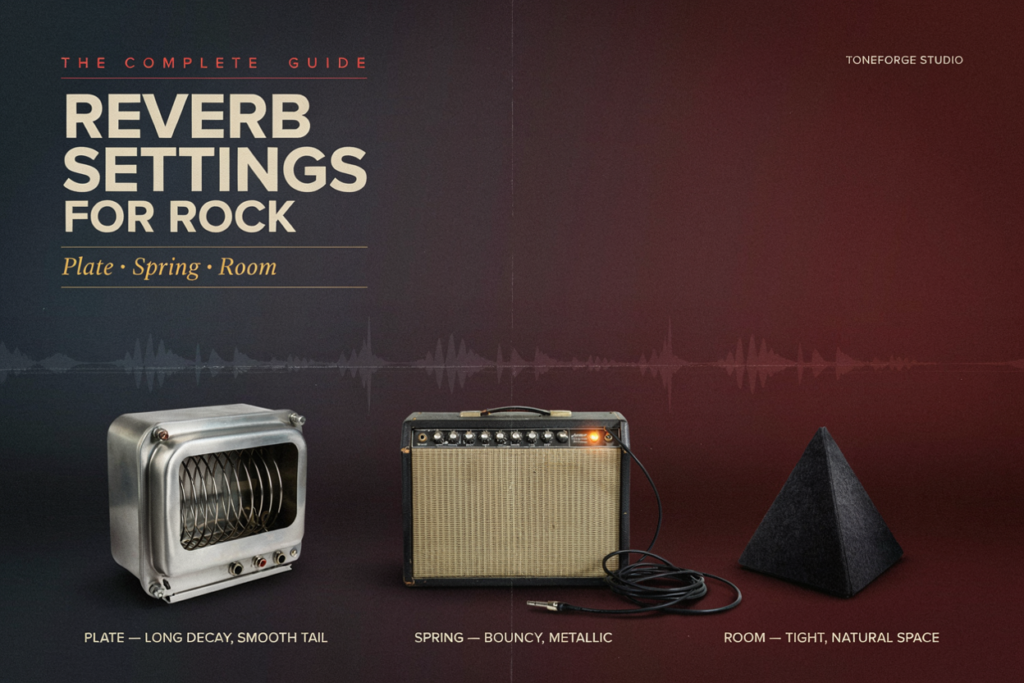
Effective reverb settings for rock begin with a 0.4–0.9-second room for cohesion, a 1.2–2.0-second plate or chamber for lead vocals, and a 0.7–1.5-second plate or room for snare. Use pre-delay to preserve attacks, filter unnecessary lows and highs from the return, and shorten the decay until the tail clears the next lyric, riff, or drum hit.
These ranges are starting points. Sparse songs support longer tails than dense arrangements, while recordings with room ambience may need little artificial reverb. This overview of practical DAW reverb controls explains decay, pre-delay, balance, and filtering.
What Are the Best Reverb Settings for Rock?
The best settings preserve punch while placing the performance in a convincing space. Start with one shared room, add a plate or chamber to featured sources, and adjust tails in the full arrangement.
Quick Rock Reverb Starting Settings
| Source | Reverb type | Decay | Pre-delay | Primary purpose |
|---|---|---|---|---|
| Lead vocal | Plate or chamber | 1.2–2.0 s | 20–80 ms | Size with intelligibility |
| Snare | Plate or room | 0.7–1.5 s | 10–35 ms | Weight and sustain |
| Toms | Room, plate, or gated | 0.5–1.2 s | 0–25 ms | Controlled impact |
| Full drum kit | Short room | 0.4–0.9 s | 0–20 ms | Kit cohesion |
| Rhythm guitar | Short room | 0.3–0.8 s | 0–20 ms | Depth without blurred riffs |
| Lead guitar | Plate, chamber, or room | 0.8–1.8 s | 15–50 ms | Separation and sustain |
Decay is the reverberant fade time. Pre-delay is the pause between dry sound and reverb onset. It preserves attacks, but too much sounds detached. See how pre-delay affects clarity for details.
Which Reverb Types Suit Rock Music?
A short room creates cohesion. A chamber gives featured parts depth, while a plate supplies a dense tail for vocals and snares. Spring adds guitar character; gated reverb creates oversized drums with abrupt tails.
Long halls work best selectively because they can soften transients and fill rhythmic gaps. A guide to balancing reverb in a mix helps when effects compete.
How Should You Set Reverb on Rock Vocals?
Start vocals with a 1.2–2.0-second plate or chamber and 20–80 ms of pre-delay. Shorten decay or reduce the send until the tail stops covering the following lyric.
How Do You Keep Rock Vocal Reverb Clear?
High-pass the return to remove lows that compete with bass and kick. Darken the upper range when sibilance makes the tail fizzy. Set filter points in the full mix rather than copying fixed frequencies.
If the vocal still moves backward, increase pre-delay modestly or duck the return during phrases so it rises in the gaps. These vocal reverb techniques help distinguish a forward vocal from an intentionally distant one.
Should Verses and Choruses Use Different Settings?
Automation lets a restrained verse send keep the vocal intimate while a higher chorus send or longer secondary tail enlarges the hook. Ensure the tail does not spill awkwardly into the verse.
What Reverb Settings Work for Rock Drums?
Use room microphones first, then add artificial reverb where the kit needs cohesion or sustain. A 0.4–0.9-second room can bind close microphones together; a separate 0.7–1.5-second plate or room can extend the snare.
How Should You Reverb a Rock Snare?
Choose a room for realism, a plate for smooth sustain, or a gate for a dramatic cutoff. Around 10–35 ms of pre-delay can expose the initial crack. Filter rumble and cymbal spill from the return.
For toms, start with 0.5–1.2 seconds and clear the next fill or downbeat. This drum reverb guide helps when choosing individual shell or bus sends.
When Should You Use Gated Reverb?
Gated reverb makes drums large without a long wash. Set threshold for reliable opening, hold for body, and release to support the groove. Although associated with 1980s rock, it also suits modern productions.
Should Rock Guitars Have Reverb?
Dense rhythm guitars need less reverb than leads. Try a 0.3–0.8-second room on rhythms and a 0.8–1.8-second effect on leads, then reduce it if riffs lose definition.
Treat amp spring reverb and recorded room sound as part of the tone before adding another effect. With wide double-tracked guitars, narrow ambience can add depth without blurring the image. This guide to reverb choices for guitar compares spring, room, plate, and hall options.
How Do You Avoid Washing Out Distorted Guitars?
Keep rhythm-guitar decay short, remove low-mid energy from the return, and send less from rhythms than leads. Short delay creates depth with less continuous energy. Narrow the ambience when guitars already dominate the sides.
How Do You Make Multiple Reverbs Work Together?
Build around one shared room, then add a contrasting plate or chamber for featured sources. Set auxiliary-return reverbs to 100% wet and control them with sends and return levels.
How Should You EQ a Rock Reverb Return?
Remove lows that crowd kick and bass, darken highs that exaggerate cymbals or sibilance, and cut ringing resonances. Filtering should place the return behind dry sources without making it unnaturally thin.
Should Reverb Be Stereo or Mono?
Stereo ambience adds width, while mono or narrow ambience improves localization and can evoke older productions. Neither is inherently better; keep the center clear and check mono compatibility.
How Can You Match Rock Reverb to the Song’s Tempo?
Calculate a quarter note with (60{,}000 \div BPM), then divide or multiply for other values. Decay need not equal a division, but note durations reveal whether tails cross important beats.
At 120 BPM:
| Note value | Duration |
| Sixteenth note | 125 ms |
| Eighth note | 250 ms |
| Quarter note | 500 ms |
| Half note | 1,000 ms |
| Whole note | 2,000 ms |
A tight drum room could fade near a quarter or half note, while a vocal plate might approach a whole note. Adjust by ear because algorithm, damping, source, and level affect the audible tail. The tempo-to-reverb timing method gives divisions for other BPM values.
Why Does Rock Reverb Sound Muddy or Weak?
Muddy reverb usually means excessive decay, send level, or low-frequency buildup; weak reverb may be too dark, short, or masked. Change one control at a time.
| Audible symptom | Likely cause | First adjustment |
| Vocal sounds distant | Too much return or too little pre-delay | Lower the return; increase pre-delay slightly |
| Rhythm guitars smear | Tail is too long or too wide | Shorten decay; narrow the return |
| Snare lacks size | Tail is too quiet or short | Raise the send; test a plate |
| Cymbals create a wash | Drum bleed or excessive high end | Reduce cymbal sends; darken the return |
| Low end turns cloudy | Bass-heavy returns | High-pass unnecessary reverb lows |
| Mix lacks one space | Too many unrelated reverbs | Keep one shared short room |
What Should You Change First?
Lower the return, shorten decay, filter the return, then increase pre-delay if the dry attack still needs separation. Mute unnecessary sends before changing algorithms.
How Should Settings Change Across Rock Subgenres?
Modern rock and metal often favor short, dark ambience. Classic rock supports natural rooms, plates, and chambers. Indie rock may use obvious or unusual effects; arena rock and power ballads can carry longer automated tails.
These are tendencies, not rules. The arrangement determines what survives. For an abrupt, oversized drum decay, how gated reverb works connects gate timing to the groove.
Frequently Asked Questions
Should bass guitar have reverb in a rock mix?
Bass often stays dry because reverberant lows reduce definition. For space, send only its upper frequencies to short, filtered ambience.
Can room microphones replace a reverb plugin on rock drums?
Yes. Good room microphones may provide all the depth a kit needs; artificial reverb helps when the recorded space lacks the intended size or character.
Is slapback delay better than reverb for rock vocals?
Slapback can keep a vocal immediate by producing distinct repeats instead of a continuous tail. Many mixes combine subtle slapback with a low plate or room send.
Should reverb be added before or after compression?
The dry track’s insert compression usually occurs before the send, while the return can have separate compression or ducking. Routing changes how consistently the source drives the effect.
How much reverb should be used on doubled rhythm guitars?
Use enough for depth without weakening stereo edges or timing. Wide distorted doubles often need less reverb than one clean guitar because they already have density and sustain.
Should the same rock reverb settings be used during mastering?
No. Source-specific reverb belongs in the mix, where each send can be controlled. Mastering reverb affects the entire stereo file and should be reserved for subtle corrections.

Noah Bennett is an audio engineering writer and acoustics specialist at Reverb Calculator. He focuses on reverb time calculation, room acoustics, studio sound design, and music production tools for producers, audio engineers, musicians, and home studio creators.