
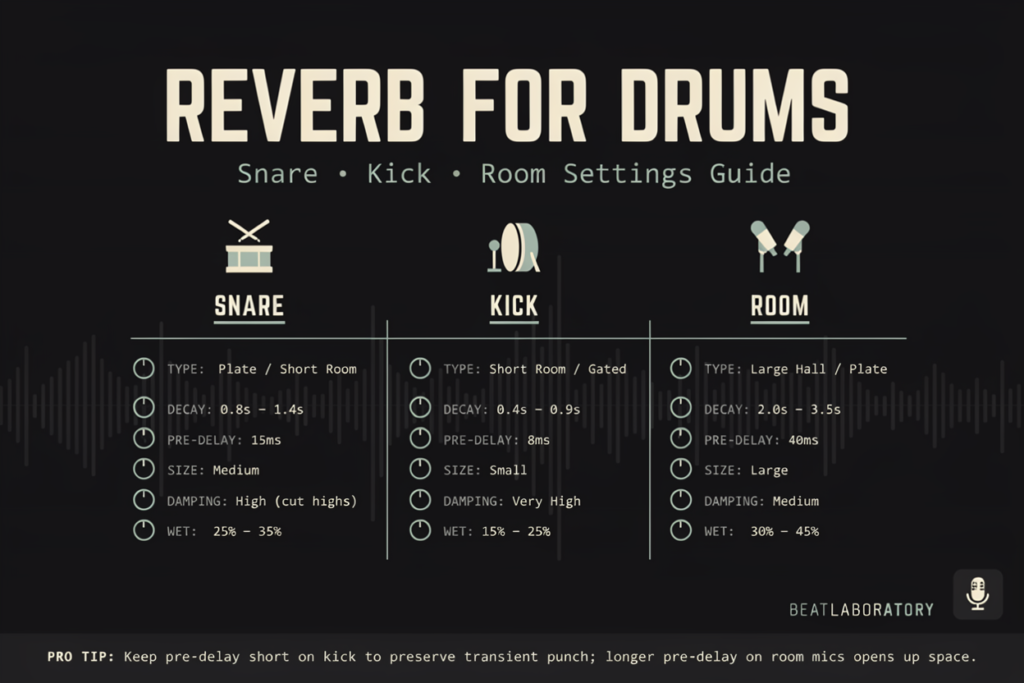
Drum reverb should add space or cohesion without blurring each hit. Start with a short room for the kit, then add a plate or gated effect when the snare or toms need more character. Keep the kick mostly dry, filter unnecessary lows, and judge adjustments in the full mix.
Understanding the main reverb controls used in a mix will make the settings below easier to adapt.
What Are the Best Reverb Settings for Drums?
A short room with roughly 0.3–0.8 seconds of decay is a practical starting point for kit cohesion. Snares and toms can support a room or plate around 0.7–1.5 seconds, while kicks usually need little or no reverb. These are starting ranges, not universal presets.
Quick Drum Reverb Settings Table
| Drum element | Reverb type | Pre-delay | Decay | Suggested filtering | Main purpose |
|---|---|---|---|---|---|
| Full kit or drum bus | Short room | 5–20 ms | 0.3–0.8 s | Reduce lows below roughly 150–250 Hz | Place the kit in one space |
| Snare | Plate or room | 15–40 ms | 0.7–1.5 s | Remove low rumble; tame harsh highs | Add size and sustain |
| Kick | Very short room, if needed | 0–15 ms | 0.2–0.5 s | Strong low cut on the return | Add subtle distance or ambience |
| Toms | Room, plate, or gated | 10–35 ms | 0.6–1.4 s | Control low-mid buildup | Enlarge fills without masking them |
| Hi-hats and cymbals | Dark room or chamber | 0–20 ms | 0.3–0.9 s | Low cut plus high damping | Add depth without excess brightness |
| Percussion | Room or plate | 5–30 ms | 0.4–1.2 s | Shape to fit the source | Position individual parts |
Pre-delay is the gap between the dry hit and the reverb. More pre-delay can preserve the transient—the sharp initial attack—while a shorter value blends the hit into the room. The role of pre-delay in perceived space explains why the same decay can feel punchy or washed out.
Why the Arrangement Changes the Settings
Fast, dense patterns leave less room for long tails than slow grooves. A 1.2-second snare plate may suit a half-time section but overlap several hits in a breakbeat. A snare with baked-in ambience also needs less added reverb than a dry sample.
How Should You Apply Reverb to Each Part of a Drum Kit?
Treat each drum according to its role rather than sending the entire kit to the same effect at the same level. The snare and toms can carry obvious ambience, while kick, hats, and cymbals usually need more restraint.
Snare Drum
A short room helps a dry snare belong with the kit. A plate creates smooth sustain when the snare needs to sound larger. Add enough pre-delay to hear the dry crack, then shorten the decay until the tail stops competing with the next hit.
See how plate reverb shapes sustained sounds for more about this effect.
Kick Drum
Keep the kick mostly dry when it carries the track’s low-end weight. Low-frequency reverb can smear the kick-and-bass relationship. If the kick sounds detached, send a small amount to the kit room and high-pass the return. Automate obvious kick reverb on isolated accents rather than every hit.
Toms
Toms often benefit from more reverb during fills. A room or plate creates depth; a gated treatment creates a large burst that ends abruptly instead of fading through the next phrase.
The classic gated reverb drum effect is particularly useful when toms or snares need dramatic size without a long tail.
Hi-Hats, Cymbals, and Overheads
Overheads and cymbals may already contain room sound. Bright, long reverb can make them harsh or distant. Use a darker short room, damp the highs, and send less than from the snare or toms.
Should Drum Reverb Use an Insert or a Send?
A send is usually most flexible because several drums can share one space while keeping independent send levels. Set the return to 100% wet, then blend it with the dry channels. Use an insert when reverb is part of one sound’s design.
Using a Shared Reverb Send
A shared room can make separate drums feel like one kit. Send the snare and toms more heavily, hats and percussion lightly, and the kick little or not at all. One EQ, compressor, gate, or sidechain can then control the return.
Good reverb mixing practice means setting the effect in context; a return that impresses in solo may overwhelm the full mix.
When an Insert Makes Sense
Use an insert for a gated snare, reversed transition, or heavily processed percussion layer. Match the output level so louder does not automatically seem better.
Using More Than One Drum Reverb
Two reverbs can solve different jobs: a short room for cohesion and a longer plate or gated return for accents. Keep their roles distinct to avoid masking.
How Do You Keep Drum Reverb Punchy and Clear?
Preserve punch by separating reverb from the transient, filtering unnecessary frequencies, and stopping tails from overlapping later hits. The return should support the groove, not become a continuous layer.
Protect the Attack With Pre-Delay
Raise pre-delay until the dry hit speaks before the ambience, stopping before it sounds like an echo. For snares and toms, 15–40 ms is useful starting territory.
Filter and Shorten the Wet Signal
High-pass filtering removes kick rumble and floor-tom resonance. Low-pass filtering or damping keeps cymbal energy from turning brittle. The relationship between tone and decay is covered in this guide to reverb frequency response.
Shorten the decay if ghost notes disappear or consecutive hits merge. You can synchronize the approximate tail to a musical subdivision with a BPM-based reverb timing method, then adjust by ear.
Gate, Duck, or Automate the Return
A gate cuts the tail below a threshold. Ducking reduces the return during each dry hit, letting ambience rise in the gaps. Automation can increase the effect for fills, then pull it back when the groove returns.
How Does Drum Reverb Change by Genre?
Genre affects the expected space, but the arrangement matters more. Rock and pop often use an audible room plus snare plate. Hip-hop and electronic productions favor dry, controlled drums with selected effects. Jazz often preserves the natural room captured by microphones. With acoustic drums, check the overhead and room tracks before adding artificial ambience.
A Practical Method for Dialing In Drum Reverb
Use this six-step process to reach a controlled result without relying on a preset:
- Mute the reverb and balance the dry kit first.
- Choose a short room for cohesion, a plate for sustain, or a gated reverb for an obvious effect.
- Set the decay so the tail clears before the next hit or phrase that needs definition.
- Adjust pre-delay until the transient stays clear without creating a separate slap.
- High-pass unnecessary lows and damp any harsh upper frequencies on the return.
- Lower the return while listening to the full mix, then automate it where fills or transitions need extra size.
Common mistakes include sending too much kick, using the same send on every drum, letting tails overlap busy patterns, and judging only in solo. For rhythmic space rather than a room impression, compare delay and reverb in a mix before adding another long tail.
Frequently Asked Questions
How much reverb should you put on drums?
Start with the return down, raise it until the space becomes obvious, then reduce it slightly and check the full arrangement.
Should a kick drum have reverb?
A kick usually works best dry, especially when it shares the low end with a bass or sub. A small amount of filtered short-room ambience can help it match the kit, while obvious kick reverb is better reserved for automated effects.
What reverb works best on a snare drum?
A short room works well for natural cohesion, while a plate adds smooth size and sustain. Gated reverb is useful when the snare should sound huge but stop abruptly instead of producing a long fade.
Should drum reverb be mono or stereo?
Stereo reverb can widen a kit, while mono reverb keeps the center focused. Check stereo effects in mono because phase interactions may change the wet signal.
How do you stop drum reverb from sounding muddy?
Shorten the decay, reduce the send level, and high-pass the reverb return to remove unnecessary low and low-mid energy. More pre-delay or ducking can also separate the ambience from each drum transient.
Is delay better than reverb for rhythmic drums?
Delay can be better when you want clearly timed repeats that reinforce the groove. Reverb is better for creating a continuous sense of space; short or tempo-aware settings can keep that space rhythmic without turning it into distinct echoes.

Noah Bennett is an audio engineering writer and acoustics specialist at Reverb Calculator. He focuses on reverb time calculation, room acoustics, studio sound design, and music production tools for producers, audio engineers, musicians, and home studio creators.