
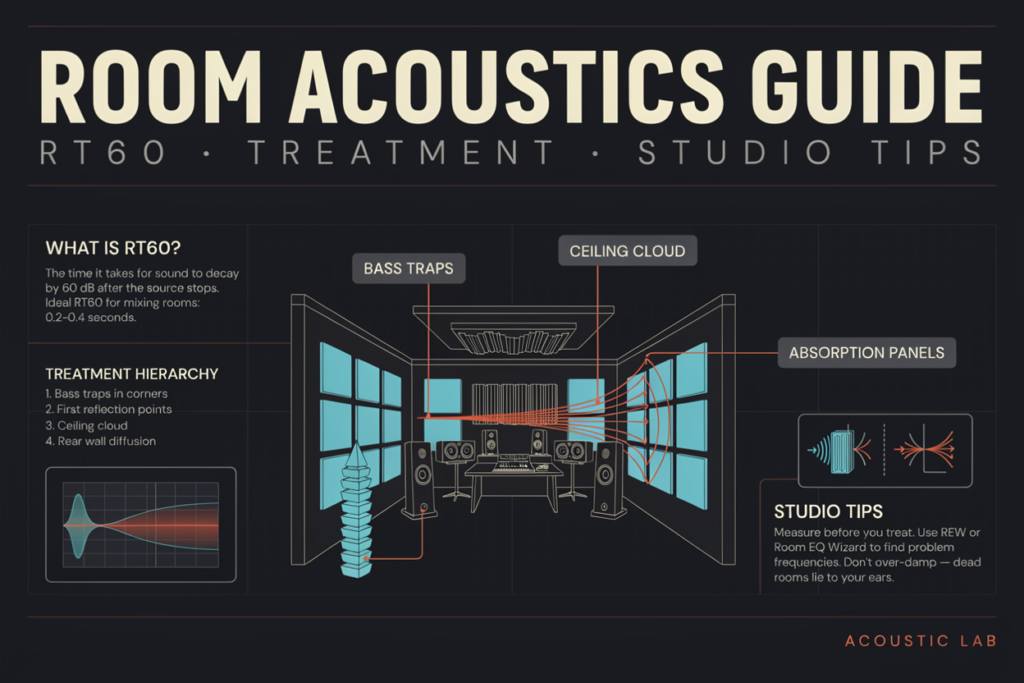
Room acoustics is the way sound behaves inside an enclosed space as direct sound combines with reflections, resonances, and reverberation. Good acoustics does not mean making a room completely dead. It means controlling these interactions so the room supports its purpose, whether that is accurate monitoring, clean recording, speech, or enjoyable listening.
What Is Room Acoustics?
Direct sound travels straight from the source, while reflected sound bounces from boundaries and objects. The timing and level of those reflections change tone, clarity, stereo imaging, and perceived size.
Direct sound, early reflections, and reverberation
Early reflections arrive shortly after the direct sound. Strong reflections can create comb filtering—a pattern of frequency boosts and cancellations—and blur stereo placement. Later reflections merge into reverberation, the sound field that remains after the source stops. See this guide to reverberation time for decay behavior.
Why frequency changes the problem
Short high-frequency wavelengths are relatively easy to absorb. Longer low-frequency waves pass through thin materials more readily and build up as room modes. Thin foam may therefore dull the top while leaving uneven bass.
Room treatment controls sound within a space. Soundproofing reduces transmission through mass, airtight construction, isolation, and vibration control. Absorptive panels cannot replace sound-isolation construction.
Which Room-Acoustic Problems Affect Sound Most?
The main room-acoustic problems are uneven bass, damaging early reflections, flutter echo, excessive decay, and background noise. Each requires a different diagnosis; adding random panels may hide one symptom while leaving its cause untouched.
| Audible symptom | Likely cause | Useful check | Typical response |
|---|---|---|---|
| Some bass notes boom while others disappear | Room modes or boundary interference | Sweep low frequencies at several positions | Move speakers/listener; add substantial bass trapping |
| Center image shifts or sounds vague | Unequal side-wall reflections | Compare left/right distances and reflection paths | Restore symmetry; treat first reflections |
| Ringing clap or metallic “zing” | Flutter echo between parallel surfaces | Clap while moving around the room | Add absorption or scattering to one or both boundaries |
| Speech or recordings sound distant | Excessive reverberation | Measure decay in frequency bands | Add appropriately distributed absorption |
| Hum, traffic, or vibration remains when playback stops | Electrical, airborne, or structure-borne noise | Isolate sources one at a time | Repair the source or improve isolation |
Room modes are dimension-related resonances. They dominate low frequencies and vary by position, so a bass note can be loud near a wall but weak at the listening seat. This overview of home-studio acoustic problems expands on small-room effects.
How Do Room Size, Shape, and Surfaces Affect Acoustics?
Dimensions determine low-frequency mode spacing; shape and materials affect reflection paths and decay. Small rectangular rooms often expose individual bass resonances clearly.
A worked axial-mode calculation
For two parallel boundaries separated by distance (L), the first axial mode can be estimated as:
[
f=\frac{c}{2L}
]
Using a sound speed (c) of approximately 343 m/s and a room length of 4 m:
[
f=\frac{343}{2\times4}\approx42.9\text{ Hz}
]
Higher modes occur at multiples of that frequency. Audible strength still depends on damping and source and listener positions.
Surfaces do not absorb every frequency equally. Carpet may reduce highs but do little at 43 Hz. Compare material data by band using frequency-dependent absorption coefficients.
How Should You Position Speakers and the Listening Area?
Positioning should precede permanent treatment because speaker and listener locations determine which modes and reflections are excited. Start symmetrically and test several positions.
Establish a stable monitoring triangle
Place the speakers equally from the centerline and aim them toward the listener. The three distances should be roughly equal, creating an equilateral triangle and an angle near 60 degrees at the listener.
Avoid placing the listener exactly halfway between front and rear walls, where modal nulls may be severe. Move the speakers and seat incrementally, listen to familiar bass material, and measure before choosing the best compromise.
How Do You Measure and Diagnose a Room?
A useful diagnosis combines dimensions, listening tests, and measurements at multiple positions. A clap or phone reading can reveal an obvious problem but cannot fully describe response, modal decay, or reflection timing.
- Define the room’s main purpose and listening area.
- Record its dimensions, openings, major furniture, and surface construction.
- Listen for tonal imbalance, image shifts, flutter echo, and lingering notes.
- Measure frequency response and an impulse response at the primary position.
- Repeat nearby to separate local cancellations from broader problems.
- Make one meaningful change, then measure again under the same conditions.
An impulse response reveals early-reflection timing and frequency-dependent decay. Review reverberation in octave or one-third-octave bands, not as one broadband number. Use RT60 ranges by room purpose as guidance, not a universal rule.
Which Acoustic Treatment Should You Use?
Choose treatment by problem and frequency range. Broadband absorption controls early reflections and mid/high-frequency decay, bass traps address low-frequency energy, and diffusion redistributes reflections without removing as much energy.
| Treatment | Main job | Common locations | Important limitation |
| Broadband absorber | Reduce reflections across a useful range | Side-wall reflection points, ceiling, rear wall | Thin panels lose effectiveness at low frequencies |
| Bass trap | Reduce low-frequency peaks and decay | Corners and boundary junctions | Requires depth, volume, or tuned design |
| Diffuser | Scatter reflected energy spatially | Often the rear wall in a suitable room | Needs enough distance to integrate properly |
| Heavy curtain or rug | Tame some upper-frequency reflections | Windows or hard floors | Not a full-spectrum solution |
Start with reflection control where it improves imaging and clarity. A ceiling cloud can be especially useful when the desk, floor, or low ceiling creates a strong vertical reflection. This explanation of broadband acoustic panels covers why placement and thickness matter.
Low-frequency ringing needs substantial treatment. Porous corner traps work by exposing thick absorptive material to areas of useful particle velocity, while pressure-based tuned systems target narrower bands. Read the bass-trap design overview before expecting lightweight foam wedges to control deep bass.
Diffusion can preserve liveliness while breaking up a strong reflection, but it needs sufficient depth and listening distance. In a very small room, absorption is often more predictable. The guide to acoustic diffuser behavior explains that scattering is frequency- and geometry-dependent.
How Can You Improve Room Acoustics Step by Step?
Improve room acoustics by fixing layout first, treating confirmed problems second, and validating every change. This priority order prevents unnecessary purchases and reduces the risk of overdamping only the high frequencies.
- Remove obvious noise and vibration sources.
- Optimize speaker and listening positions while maintaining symmetry.
- Control strong first reflections with broadband absorption.
- Add low-frequency treatment where measurements show modal buildup or long decay.
- Treat flutter echo or excessive overall decay without covering every surface.
- Consider diffusion only when the room and listening distance support it.
- Apply electronic room correction after physical setup; it can adjust response at the seat but cannot remove a reflection or shorten acoustic decay.
Measure before and after each major change. If high frequencies fall quickly while bass continues ringing, more thin absorption is not the answer. A complete acoustic-treatment planning guide can help connect the measured problem to an appropriate physical solution.
Room Acoustics FAQ
What is the difference between room acoustics and soundproofing?
Room acoustics controls reflections, resonances, and decay inside a room. Soundproofing reduces sound transmission between spaces through construction methods such as added mass, airtightness, decoupling, and vibration isolation.
Can acoustic foam fix bass problems?
Thin acoustic foam mainly absorbs upper and some midrange frequencies. Deep-bass control usually requires much thicker porous absorbers, large air gaps, or correctly designed tuned traps.
Where should acoustic panels be placed first?
In a monitoring room, the first priorities are commonly the side-wall and ceiling reflection points between the speakers and listener. Exact placement should follow the speaker layout and measurement results, not a generic wall-coverage pattern.
How can you test room acoustics without professional equipment?
Listening to low-frequency sweeps, clapping for flutter echo, and comparing several positions can reveal obvious issues. These checks are preliminary; calibrated measurements provide more reliable frequency-response, reflection, and decay information.
Can a room have too much acoustic treatment?
Yes. Excessive thin absorption can remove high-frequency energy while leaving low-frequency decay uncontrolled, producing an unnaturally dull but still inaccurate room. Balanced treatment should address the full problem range and retain useful reflections.
Should room-correction software be used before or after treatment?
Use correction after speaker placement and practical physical treatment. Equalization can reduce some response errors at a listening position, but it cannot stop flutter echo, remove early reflections, or absorb lingering modal energy.

Noah Bennett is an audio engineering writer and acoustics specialist at Reverb Calculator. He focuses on reverb time calculation, room acoustics, studio sound design, and music production tools for producers, audio engineers, musicians, and home studio creators.